Roof Waterproofing Foil Laminate: Selection Tips for Four Roof Types

Roof leaks, condensation, and temperature swings are the three headaches that keep building owners and contractors awake at night. Many projects treat waterproofing and thermal insulation as separate systems: the waterproof layer ignores thermal bridging, and the insulation layer fails to stop water vapor. The result is repeated repairs and recurring leaks. Aluminum foil composite laminate integrates water barrier, vapor barrier, and reflective insulation in a single layer. Installed between the roof deck and the finish, it tackles both leakage and energy loss at once. For waterproofing membrane converters, the rule is simple: the downstream project's roof type determines the laminate structure — choose the wrong one, and the finished membrane comes back. This article breaks down material selection for four typical roof types.
Two Material Routes to Start With
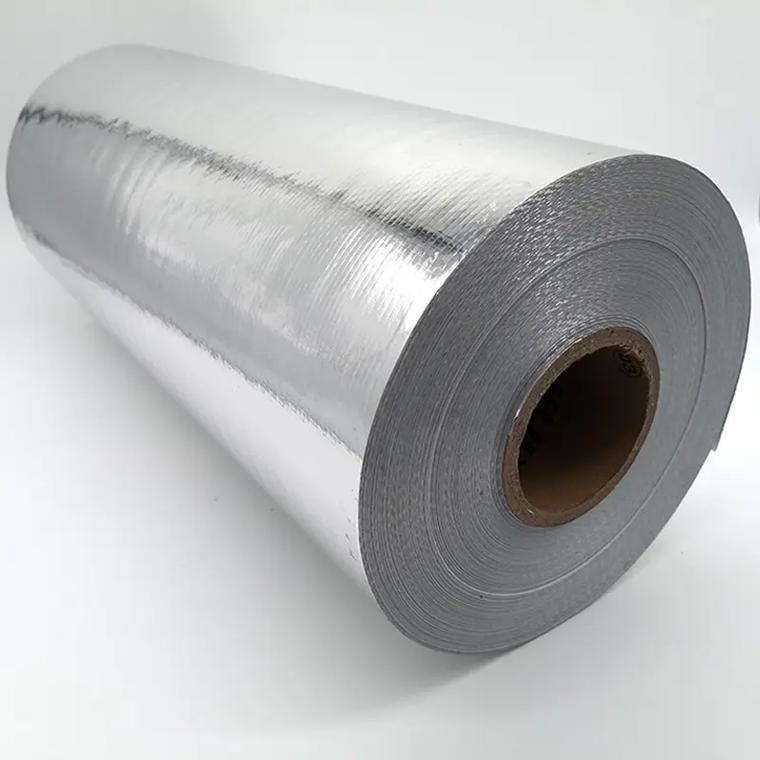
By reflective layer, the market splits into two routes: pure aluminum foil laminates (AL/PE, PET/AL/PE) and metallized film laminates (VMPET/PE). Pure foil is conventionally supplied in the 6μm-9μm range, with 9μm as the heavy grade, offering high reflectivity, corrosion resistance and long service life. Metallized film is lighter and lower in cost, suited to large-area applications where design life requirements are moderate. Telling them apart is easy: a multimeter reads near-zero resistance on pure foil, while metallized film is essentially non-conductive. Before placing the order, define the downstream roof type and design life first, then match the structure.
Selecting by Roof Type
Industrial metal roofs. Metal roofs have many seams and expand and contract significantly with temperature; leakage concentrates at laps and penetrations rather than in the panel field. Flexibility, tear resistance and aging resistance matter more than thickness. Recommended structure: PET/AL/PE three-ply or AL/PE two-ply. The PET layer provides dimensional stability, the aluminum layer reflects heat, and the PE layer acts as a moisture and vapor barrier against the steel sheet or insulation batts. Select foil thickness by project life: standard 6μm covers ordinary factories, while the 9μm heavy grade suits demanding or corrosive environments. Match roll width to the metal sheet width to minimize field overlaps.
Residential pitched roofs. Leaks usually originate from broken tiles or blocked gutters, so the laminate here serves as a secondary drainage plane and vapor barrier beneath the battens or above the insulation. The key is balancing vapor resistance with breathability: a fully sealed AL/PE film can trap moisture against its underside when indoor humidity is high, so consider a microporous or partially breathable laminate, or design vent paths at ridges and eaves. A 6μm aluminum layer is sufficient for reflectivity; the critical parameter is PE puncture resistance, because roofers walk on the membrane and drop tools during tile installation.
Cold-storage steel roofs. Cold stores face the most extreme two-way temperature difference: the outer surface may exceed 60°C in sunlight while the interior stays below -18°C. The laminate must combine high reflectivity, low emissivity, strong vapor resistance and low-temperature toughness. Specify pure foil PE laminate or double-sided PET/AL/PE with the 9μm heavy-grade aluminum layer; the PE layer must stay flexible at low temperature to avoid brittle cracking. Remind downstream installers to overlap sheets by at least 100 mm and seal fastener holes and laps with compatible tape — a single pinhole becomes a water-vapor highway into the insulation.
Sunrooms and skylights. The laminate is fixed beneath polycarbonate panels or glass as a reflective layer, so low weight, weather resistance and easy installation matter most. Metallized laminate works for retrofits; for new builds with longer design life, a 6μm foil PE laminate is preferable. Keep the aluminum layer away from acidic sealants, which can corrode and blacken the reflective surface.
A note on sourcing: whatever the roof type, converters should request test data with every batch — reflectance, peel strength, WVTR and foil thickness — and keep retention samples for batch-to-batch comparison. A laminate that passes on sample but drifts on production lots is the most expensive failure mode of all, because it is usually discovered on the roof, not in the warehouse. Working with a raw material supplier who can guarantee consistent foil gauge and bond strength across lots is therefore not a procurement nicety but a quality-control foundation for the whole membrane line.
Five Parameters to Check on Delivery
First, aluminum layer material and thickness: the contract must state pure foil or metallized film; standard thickness is 6μm-9μm with 9μm as the heavy grade — verify by measurement or grammage back-calculation. Second, bond strength: peel strength of no less than 1.5 N/15 mm; tear a sample by hand, and large foil transfer to the opposite face indicates insufficient adhesive application or curing. Third, aging resistance: metal roofs and coastal projects require UV aging and salt-spray data. Fourth, water-vapor transmission rate: prioritize low-WVTR products for cold stores, indoor pools and other high-humidity buildings. Fifth, slitting and roll condition: flat roll ends, tight width tolerance and few splices — roof membranes run in continuous lengths of tens of meters, and every splice is a potential leak path. Ideally, these five items are written directly into the purchase contract and checked against measured data on every incoming lot, not just the approval sample.
Three Common Mistakes
Mistake one: treating one structure as universal. Metal roofs need tear resistance, pitched roofs need a breathability balance, and cold stores need low-temperature toughness and low WVTR — one laminate cannot cover every roof type. Mistake two: looking only at thickness and ignoring structure. Three laminates can all claim a 9μm aluminum layer, yet AL/PE, PET/AL/PE and VMPET/PE differ significantly in performance and price; lamination quality and substrate matching matter more than thickness alone. Mistake three: neglecting overlaps and details. The roll stock itself rarely leaks — more than eighty percent of leaks occur at laps, penetrations and eaves, so confirm compatible tapes and installation standards at the same time.
Hongcheng Technology, as an aluminum-plastic laminate raw material supplier, provides AL/PE, PET/AL/PE and VMPET/PE roll materials to waterproofing membrane converters and insulation product manufacturers, with aluminum layers from 6μm to 9μm, customizable width and bond strength, and test data issued with every batch. We do not manufacture finished waterproofing membranes. For samples and custom specifications, feel free to contact us.
Techfoil +86 13758223270 Email: wendy@hcdxcl.com.cn
Single-Sided vs Double-Sided Foil Laminate: Structure and Selection Logic for Ventilation Duct Facing