Aluminum Foil Shielding Tape for Cables: 2026 Market Trends and What Cable Engineers Need to Know

For engineers and procurement teams working in cable manufacturing, aluminum foil shielding tape is not a glamorous material — it is simply one that has to work, every time, at scale. In 2026, the stakes around getting this material right are higher than ever, as demand for shielded cables accelerates across new energy infrastructure, data communications, and automotive electrification.
This article covers where the market is heading, what is driving demand, and the technical parameters that matter most when specifying aluminum foil composite shielding materials.
Market Overview: 8.1% CAGR Through 2032
The global aluminum foil shielding tape market reached approximately USD 104 million in 2025. Industry research projects this figure to grow to USD 177 million by 2032, representing a compound annual growth rate of 8.1%. This is not a commodity market drift — it is a structural expansion driven by the electrification of everything.
Three demand vectors are pulling simultaneously in 2026:
New energy infrastructure is the most powerful driver. Ultra-high voltage transmission lines, offshore wind farm submarine cables, and grid interconnection projects across Asia, Europe, and North America all require shielded cables at a scale that dwarfs historical demand. China alone is investing heavily in long-distance power transmission corridors, each requiring millions of meters of cable with verified shielding performance.
Data center construction is the second driver. Hyperscale data centers — the kind being built by major cloud providers globally — require dense, tightly managed cable infrastructure where electromagnetic interference between runs is a design constraint, not an afterthought. Aluminum foil shielding tape is the cost-effective solution for signal integrity in high-density cable trays.
New energy vehicles are the third driver. Each EV contains a complex wire harness — increasingly sophisticated as power electronics, sensors, and communication systems multiply. The wire harness in a modern EV can exceed 3 kilometers in total length, with a significant proportion requiring shielding. Aluminum foil composite tape, bonded to non-woven or woven backing, is the standard shielding layer in automotive-grade wire harnesses.
The Technical Case for Aluminum Foil Composite Shielding
Not all shielding solutions are equal. The choice between aluminum foil composite tape, braided wire shielding, and spiral wrap shielding involves trade-offs in shielding effectiveness, flexibility, weight, and cost. For the majority of communication, control, and medium-voltage power cable applications, aluminum foil composite tape delivers the best balance.
The reasons are well understood in the industry:
Shielding effectiveness scales with foil thickness and continuity. A properly specified aluminum foil composite tape — with foil thickness in the 7–25 micron range and a well-bonded backing layer — achieves shielding effectiveness of 60–90 dB across the relevant frequency range, which meets or exceeds the requirements of most communication and industrial control cable standards.
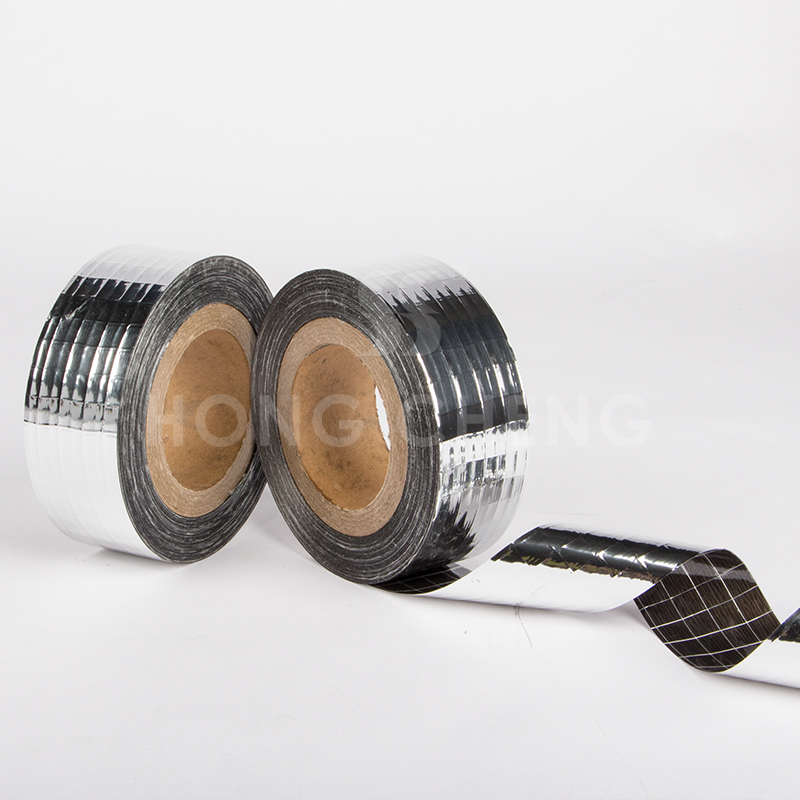
The composite structure is what enables practical deployment. Bare aluminum foil is brittle and tears easily during the cable wrapping process. Bonding the foil to a woven polyester, woven fiberglass, or non-woven backing layer gives it the mechanical durability to withstand repeated bending, twisting, and the tensile forces of high-speed cabling machines. The interlayer bond strength — a direct function of the lamination process — determines how the tape performs over the cable's service life.
Dry lamination is the preferred process for cable-grade shielding tape. Compared to wet lamination, dry lamination produces higher and more consistent interlayer bond strength, with no solvent residues that can cause delamination under heat or humidity cycling. Cable manufacturers sourcing shielding tape for demanding applications should specify dry lamination as a process requirement, not merely a preference.
Key Specifications to Define When Sourcing
For cable procurement and engineering teams, the following parameters should be explicitly specified — not left open to supplier interpretation:
Foil thickness is the primary shielding parameter. For standard communication and control cables, 9–12 microns is typical. For cables requiring higher shielding performance — industrial control in high-interference environments, or cables adjacent to high-power conductors — 15–25 microns is appropriate. Foil alloy should be specified as 1235 or 8011 for consistent conductivity.
Backing material selection depends on the application. Polyester non-woven is standard for most communication cable applications — lightweight, cost-effective, and sufficient for moderate flexibility requirements. Woven polyester or woven fiberglass backing is specified for cables requiring higher tensile strength during wrapping or for applications involving significant thermal cycling. The choice of backing also affects the tape's elongation at break and resistance to tear propagation.
Slit width tolerance is a practical production parameter that cable manufacturers frequently underspecify. On high-speed cabling lines, width variation of more than ±0.3–0.5mm causes misalignment, wrinkle formation, and in some cases machine stoppages. Specifying slit tolerance explicitly — and requiring the supplier to provide measurement data — protects your production yields.
Bond strength should be tested and reported, not assumed. Request peel strength data (typically measured per 25mm width) from the supplier, and align it to your cabling line tension parameters. A tape that passes bench testing but delaminates at wrapping tension is a production problem waiting to happen.
Supply Chain Considerations for 2026
The aluminum foil composite shielding tape supply chain is relatively concentrated. A small number of specialized composite material manufacturers dominate high-volume, quality-certified supply. For cable manufacturers managing dual-source strategies or qualifying new suppliers, the key evaluation criteria are consistent:
Production capacity and output consistency matter more than unit price at scale. A supplier who can reliably deliver to specification across large volumes, with consistent lot-to-lot quality, is worth more than a lower-priced alternative with variable output. Request production capacity data and ask for lot-to-lot consistency records.
ISO 9001 certification is a baseline expectation, not a differentiator. Look beyond the certificate to the supplier's in-process quality controls: do they measure foil thickness per roll? Do they test bond strength per lot? Are slit width measurements recorded? The depth of quality documentation reflects the seriousness of the quality system.
Customization capability is increasingly important. As cable designs evolve — particularly in the new energy and automotive sectors — shielding tape specifications are being customized to application requirements rather than selected from standard catalogues. Suppliers able to adjust foil thickness, backing type, width, and lamination parameters to specification are better long-term partners than those offering fixed catalogue items only.
Outlook for Cable Shielding Materials
The structural demand drivers behind aluminum foil shielding tape growth — power infrastructure expansion, data center construction, and EV wire harness complexity — are all multi-year trends with policy and investment backing. The 8.1% CAGR projection through 2032 is grounded in committed infrastructure programs, not optimistic extrapolation.
For cable manufacturers and their procurement teams, the practical implication is to treat shielding tape as a strategic sourcing category — one where supplier qualification, specification discipline, and supply security deserve deliberate attention.
Hongcheng Technology has manufactured aluminum foil composite shielding materials for the cable industry for 17 years. Our shielding tape products are available in foil thicknesses from 7 to 25 microns, with polyester and fiberglass backing options, produced via dry lamination for consistent bond strength. Annual capacity exceeds 20,000 tons. Samples available on request.
Data sources: QYResearch, Fortune Business Insights, industry research publications.
Aluminum Foil Flexible Duct Materials: What HVAC Engineers and Procurement Teams Need to Specify in 2026
Aluminum Foil Composite Materials Driving Growth in Industrial Ventilation: 2026 Market Outlook