Export Equipment Vacuum Packaging: How Aluminum Foil Woven Fabric Laminate Protects Heavy Machinery on Long-Haul Sea Routes
In the first half of 2026, China's machinery and equipment export sector continues to post steady growth. According to the General Administration of Customs, exports of general mechanical equipment and components rose 11.3% year-on-year between January and May, with new energy equipment, injection molding machines, compressors and precision machine tools accounting for a growing share of high-value shipments.
Yet behind this growth, exporters are wrestling with a familiar but stubborn quality problem: moisture damage, rust and mold during long ocean voyages. In Ningbo, Suzhou and Foshan—three of China's coastal manufacturing hubs—equipment makers have recently reported a sharp increase in demand for aluminum foil woven fabric laminate as the core material in vacuum packaging and wooden case moisture barrier liners.
Why Long-Haul Shipping Is Making Moisture Protection Harder
Ocean cargo holds undergo significant diurnal temperature swings. At night, the temperature drops and relative humidity inside the hold can climb above 95%. Standard PE stretch film blocks liquid water, but it cannot stop water vapor molecules from slowly migrating through the film over a 30 to 60-day voyage. A single injection molding machine or CNC tool worth hundreds of thousands of RMB, with as little as 20 milliliters of residual moisture inside, may show visible oxidation on metal contact surfaces by the time it reaches the destination port. The cost of post-arrival rework, cleaning and re-machining can easily run into tens of thousands of RMB per unit.
For equipment manufacturers, moisture-protective packaging is no longer an auxiliary process—it has become a critical link in the quality chain.
Why Aluminum Foil Woven Fabric Laminate Stands Out
The laminate uses a three-layer or multi-layer construction—aluminum foil, PE film and woven fabric—to deliver both barrier performance and mechanical strength:
- Aluminum foil layer: blocks water vapor, oxygen and light, with water vapor transmission rate controlled below 0.1 g/m²·24h;
- PE lamination layer: provides heat-sealability for clean, strong seals after vacuum drawing;
- Woven fabric layer: delivers excellent tear and puncture resistance, withstanding the abrasion of equipment edges and the impact of road or sea vibrations.
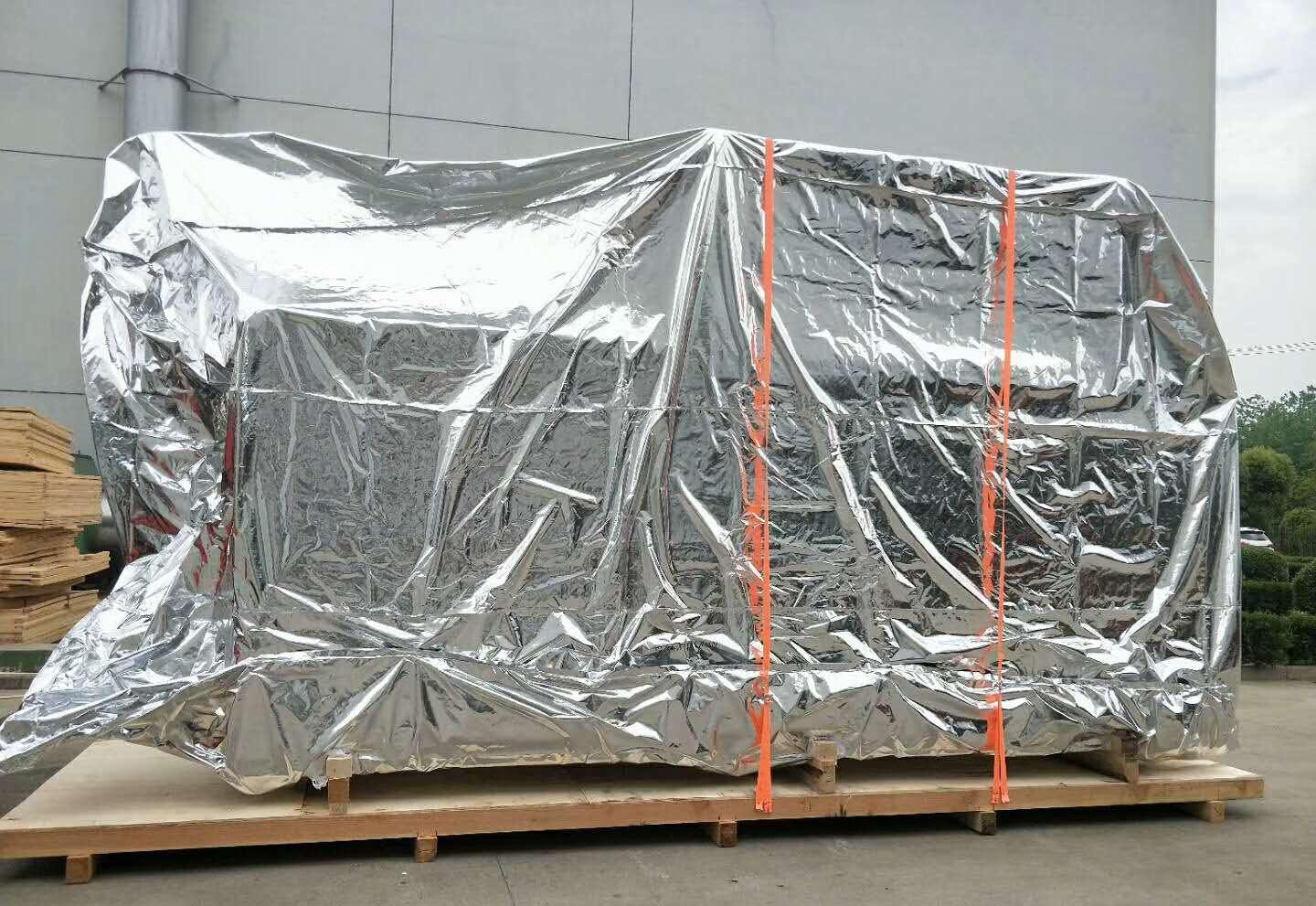
This structure works equally well as a full-body vacuum hood over a complete machine, or as cut-to-size wooden case liners and crate bottom cushions. Under vacuum, the aluminum foil layer conforms tightly to the equipment profile while the woven fabric layer distributes stress and prevents the film from being punctured by sharp protrusions.
Three Specifications Serious Exporters Should Check
With a wide range of laminate specifications on the market, purchasing teams should focus on three indicators before placing orders:
- Moisture and oxygen barrier performance: water vapor transmission rate below 0.5 g/m²·24h and oxygen transmission rate below 50 cm³/m²·24h·atm indicate a high-barrier product;
- Tear strength: machine direction ≥80N, transverse direction ≥70N, with woven fabric density of at least 12×12 threads per inch;
- Heat seal strength and elongation: peel strength at the seal ≥25N/15mm and film elongation ≥15% to prevent stress cracking during vacuum drawing.
For shipments to Europe and North America, buyers should also confirm REACH and RoHS compliance, and check for UV aging resistance if equipment is stored outdoors before installation.
Application Expansion and Customization Trends
Aluminum foil woven fabric laminate is moving well beyond traditional machinery export applications. End-use cases now include wind turbine main shafts, medical imaging systems, precision instruments and new energy battery modules. Customer requirements are becoming increasingly tailored:
- Full equipment vacuum hoods up to 6m × 8m, requiring custom widths and pre-fabricated sealing edges;
- Multi-layer protective systems combining aluminum foil laminate with corrugated cardboard or EPE foam;
- Woven-fabric-reinforced vacuum bags for storing castings, molds and precision parts.
Hangzhou Hongcheng Technology, a professional Chinese manufacturer of aluminum foil composite materials, offers end-to-end support from substrate selection and thickness design to width customization and process guidance. The company's products are supplied steadily to equipment manufacturers in Southeast Asia, Europe and North America, with annual export volumes maintaining stable growth.
Conclusion
In a global supply chain environment where shipping cycles are getting longer and humidity conditions harder to control, aluminum foil woven fabric laminate is shifting from an optional upgrade to a baseline requirement. For equipment exporters, choosing a laminate supplier with stable material structure, flexible customization and reliable batch supply is now a direct driver of arrival quality and brand reputation.
— Contact Hongcheng Technology
- Phone/WeChat: +86 13758223270
- Email: wendy@hcdxcl.com.cn
Thin-Profile AL/PET Shielding Tape Selection Guide for High-Speed Data
Aluminum Foil PET Decorative Laminate in Wood Door Facing: Application and Selection Guide