Fiberglass Mesh Aluminum Foil: A Detailed Explanation of Characteristics, Processes and Multi-Field Applications
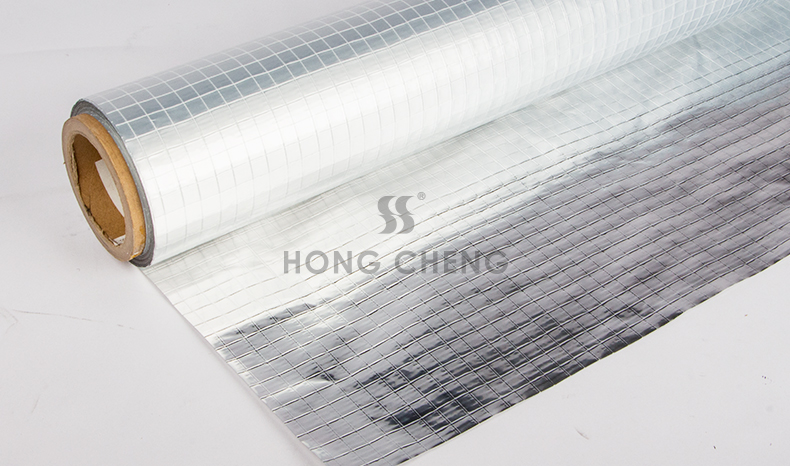
Fiberglass mesh aluminum foil is a multifunctional composite material made of fiberglass mesh cloth and high-purity aluminum foil through special composite processes. Integrating the high strength of fiberglass and the barrier protection properties of aluminum foil, it is widely used in many fields such as building energy conservation, HVAC, industrial pipelines, and electromagnetic shielding, becoming an indispensable core auxiliary material in modern industrial and construction fields. A thorough understanding of its characteristics, processes and applications is of great significance for material selection, production and application control. The following comprehensively details fiberglass mesh aluminum foil from multiple dimensions.
The core structure of fiberglass mesh aluminum foil is a composite system of "fiberglass mesh cloth + aluminum foil", which are firmly combined through hot pressing, gluing or vacuum composite methods to form a functional material with complementary advantages. Among them, the fiberglass mesh cloth, as the base material, is usually woven from alkali-free or medium-alkali glass fiber yarns. After being coated with alkali-resistant polymer emulsion, it has excellent mechanical strength, dimensional stability and high temperature resistance. Its monofilament diameter is only a few microns to more than twenty microns, and each bundle of fiber filaments is composed of hundreds or even thousands of monofilaments, which can provide solid support for the overall material and effectively improve tear resistance and tensile strength. The aluminum foil layer adopts high-purity aluminum foil with a thickness of 6-50 microns, endowing the material with good water vapor barrier, heat reflection and electromagnetic shielding properties. The combination of the two completely makes up for the shortcomings of single aluminum foil being easy to break and single fiberglass mesh cloth having no barrier property.
The preparation of high-quality fiberglass mesh aluminum foil requires multiple precise processes, and the core processes include fiberglass mesh cloth pretreatment, aluminum foil surface treatment, composite molding, and cutting inspection. First, the fiberglass mesh cloth is degreased and alkali-resistant treated to improve its corrosion resistance and adhesion to aluminum foil; at the same time, the aluminum foil is subjected to surface oxidation treatment to enhance its oxidation resistance and adhesion. Some high-end products also adopt atomic layer deposition (ALD) alumina coating to further improve corrosion resistance, adapting to coastal high-humidity and high-salt environments. Then, the fiberglass mesh cloth and aluminum foil are closely combined through hot-press composite technology. Some products add heat-resistant adhesive or thermoplastic materials between them to ensure that the composite layer is not easy to delaminate; finally, precise slitting and strict inspection are carried out to ensure uniform product thickness and accurate dimensions, meeting the application needs of different scenarios.
Excellent comprehensive performance is the core advantage of fiberglass mesh aluminum foil being widely used. First, it has outstanding mechanical properties. The reinforcing effect of the fiberglass mesh greatly improves the tensile strength of the material, with high longitudinal and transverse tensile strength, not easy to tear or deform, good bending performance, which can adapt to various processing methods such as winding and laminating, effectively resist external pulling, and maintain structural stability in complex environments. Second, it has excellent barrier protection performance. The aluminum foil layer can effectively block water vapor, air and heat, with water vapor permeability as low as below 0.01g/(m²·24h), and can reflect more than 80% of infrared rays, with moisture-proof, heat-insulating and thermal insulation effects, making it an ideal outer protective layer for thermal insulation materials. Third, it has good fire resistance, flame retardancy and weather resistance. Fiberglass itself is non-combustible, and aluminum foil is high-temperature resistant. The combination of the two can achieve good flame retardant effect, with a temperature resistance range of -40℃ to 120℃, which can still maintain structural stability in extreme temperature difference environments, and the service life is as long as 15 years, 50% longer than traditional materials. In addition, it also has good electromagnetic shielding and acid-base corrosion resistance, adapting to various complex working conditions.
Combined with industry needs, fiberglass mesh aluminum foil is mainly divided into three categories: single-sided composite, double-sided composite and sandwich multi-layer composite, adapting to different application scenarios. In the construction field, it is widely used for the outer protection of HVAC air ducts and cold and hot water pipes, as the outer protective layer of thermal insulation materials such as rock wool and glass wool, playing the roles of flame retardancy, corrosion resistance, heat insulation and sound absorption. At the same time, it can be used for building wall thermal insulation to help buildings save energy and reduce consumption. In the industrial field, it is mainly used for the protective wrapping of oil transmission pipelines and chemical steam pipelines to block water vapor penetration and reduce heat loss. It can also be used for electromagnetic shielding of electronic equipment to effectively shield electronic interference. In addition, it can also be used as moisture-proof, fog-proof and corrosion-proof packaging material for export equipment, protecting equipment from damage during transportation and storage, with application scenarios covering construction, industry, electronics, new energy and many other fields.
With the popularization of green energy-saving concepts and the upgrading of industrial technology, the market's requirements for the performance of fiberglass mesh aluminum foil are constantly improving, promoting its development towards high-end and customization. According to industry statistics, the penetration rate of alumina-plated fiberglass mesh aluminum foil in East China and South China has exceeded 38%, becoming the first choice for high-end scenarios. In the future, through process optimization and technological innovation, fiberglass mesh aluminum foil will further improve its flame retardant grade, barrier performance and mechanical strength, expand its application in high-end fields such as aerospace and new energy equipment, and at the same time achieve more environmentally friendly and thinner production, providing more reliable material support for the high-quality development of various industries.
Price Range and Core Differences of Aluminum Foil Composite Film
Detailed Explanation of Flame-Retardant Single-Sided Shielding Aluminum Foil (AL+Flame Retardant+PET) for Cable Shielding Layers