FS Aluminum Foil Scrim Laminate: The Lightweight Facing Material for Flexible HVAC Ducts
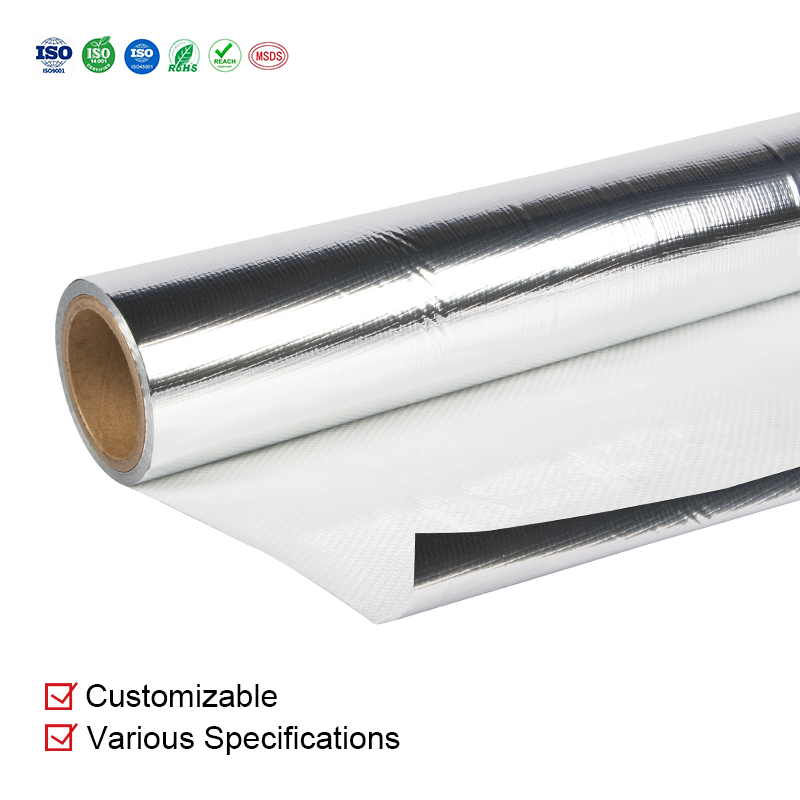
As central air conditioning systems rapidly expand into premium commercial buildings, data centers, and modular construction, the performance requirements for flexible duct facing materials are quietly evolving. FSK (Foil/Scrim/Kraft) has long set the industry benchmark, but in applications where lighter weight, thinner profile, and faster installation are priorities, the FS structure — a two-layer composite of aluminum foil and scrim without the kraft paper backing — is gaining increasing adoption among flexible duct manufacturers.
This article focuses on the structural principles, performance advantages, typical specifications, and key procurement parameters of FS aluminum foil scrim laminate, serving as a practical reference for duct manufacturers, insulation fabricators, and HVAC material buyers.
1. The FS Structure: Engineering Logic Behind Lightweight Design
FS composite (Foil/Scrim laminate) consists of two functional layers:
- Face Layer (Aluminum Foil): Provides thermal reflection and moisture vapor resistance. Foil thickness typically ranges from 7μm to 9μm. Aluminum foil reflects over 95% of radiant heat, effectively blocking radiative heat transfer.
- Scrim Layer: A fiberglass mesh or polyester woven grid bonded to the foil backing, delivering tensile strength in both machine and cross-machine directions. This prevents the foil from cracking or delaminating during installation bending.
Compared to the three-layer FSK structure, FS eliminates the kraft paper backing, resulting in a thinner total thickness, lower basis weight per unit area, and lighter roll weight at the same width — all of which ease installation in congested overhead spaces typical of commercial ceiling plenum areas.
One important distinction: without the kraft paper layer, FS does not offer a direct adhesive bonding surface as FSK does. When used with tape sealing or adhered directly to insulation batts, FS typically requires a pre-applied adhesive treatment or an additional PE lamination — which is the primary differentiator between FS and FSK in practical application.
2. Key Performance Properties
① Thermal Reflection Aluminum foil's high reflectivity in the near-infrared spectrum makes it highly effective at blocking radiant heat. In ventilation systems with significant temperature differentials between duct interior and surroundings, FS facing can reduce radiant heat loss to less than 10% of the uninsulated baseline — measurably improving system energy efficiency.
② Moisture Vapor Barrier Aluminum foil has a near-zero water vapor transmission rate (WVTR), effectively preventing ambient humidity from penetrating insulation materials. This is particularly important in humid subtropical climates and marine environments, where moisture ingress can degrade insulation performance significantly over time.
③ Structural Reinforcement Against Cracking The scrim layer provides multi-directional tear resistance. During installation bending, transport vibration, or internal pressure fluctuation, the mesh distributes stress and prevents the foil from cracking — extending the service life of the duct assembly.
④ Lightweight and Easy Fabrication Compared to FSK, FS composites are approximately 20%–30% lighter per unit area. Manufacturers can specify custom widths (commonly 500mm to 1500mm) and roll lengths to minimize waste and optimize their production line feed.
3. Typical Specification Comparison
| Parameter | Standard FS | Heavy-Duty FS | Economy FS |
|---|---|---|---|
| Foil Thickness | 9μm | 12μm | 7μm |
| Scrim Type | Fiberglass mesh | Dense fiberglass | Polyester woven |
| Basis Weight (g/m²) | ~55–65 | ~75–85 | ~45–55 |
| Operating Temp. Range | -30°C ~ 120°C | -40°C ~ 150°C | -20°C ~ 100°C |
| Typical Application | Commercial HVAC duct | Industrial / high-temp duct | Residential split-system duct |
| Custom Width Range | 500–1500mm | 500–1250mm | 500–1000mm |
Foil thickness is the primary selection variable: 7μm suits lightweight residential applications, 9μm is the commercial HVAC standard, and 12μm is reserved for industrial high-temperature or corrosive-environment applications. Higher scrim density improves tear resistance but increases material cost accordingly.
4. FS vs. FSK: Selecting the Right Structure
| Criteria | FS (Two-Layer) | FSK (Three-Layer) |
|---|---|---|
| Basis Weight | Lower | Higher |
| Installation | Lighter, easier handling | Stiffer, more rigid |
| Adhesion | Requires adhesive treatment | Kraft paper bonds directly |
| Flame Retardancy | Depends on scrim material | Easier to meet UL94 |
| Typical Applications | Premium buildings, data centers | Traditional commercial/industrial HVAC |
| Raw Material Cost | Slightly lower | Slightly higher |
For applications prioritizing lightweight design, cost efficiency, and rapid installation, FS is the preferred solution. Where higher flame retardancy ratings or direct adhesive bonding are required, FSK remains the standard choice.
5. Procurement Checklist: Six Key Parameters
Flexible duct manufacturers and raw material buyers evaluating FS aluminum foil scrim laminate should verify the following parameters:
-
Foil Thickness and Pinhole Rate: Thickness must be measured with a calibrated micrometer. Pinhole rate directly impacts moisture barrier performance — request a pinhole rate test report from the supplier.
-
Bond Strength (Peel Strength): Peel strength between the foil and scrim layer should be ≥1.2N/25mm (≥1.5N/25mm recommended for high-tension wide-width applications) to prevent delamination during bending or tensioning.
-
Scrim Density and Material: Fiberglass mesh offers higher strength than polyester alternatives, though dust protection is needed during fabrication. Higher mesh density (e.g., ≥5×5 grid/cm²) provides better tear resistance.
-
Width Consistency and Slitting Precision: Duct production lines require consistent width feed. A slitting tolerance of ±1mm is standard; premium applications may specify ±0.5mm.
-
Flame Retardancy Rating: For export to North America or Europe, request ASTM E84 or UL 723 test reports. For domestic projects in China, reference GB 8624-2012 relevant class requirements.
-
Customization Capability: Confirm whether the supplier can accommodate special widths, double-sided foil constructions, or PE heat-seal inner layers — critical factors for compatibility with proprietary duct production equipment.
6. Market Outlook: Lightweight Design and Green Building as Dual Growth Drivers
Several structural factors are accelerating demand for FS aluminum foil scrim laminate in 2026:
Data center construction expansion: The global AI infrastructure buildout is driving massive investment in new data center facilities, where precision thermal management systems demand high-performance duct materials with tight tolerances. The lightweight profile of FS facing materials is increasingly preferred for dense overhead ductwork installations.
Deepening green building certification requirements: LEED, BREEAM, and similar green building rating systems include quantified energy efficiency requirements for building envelopes. High-reflectivity aluminum foil-faced flexible ducts contribute meaningfully to these energy credits, making specification-grade facing materials a purchasing priority for building contractors.
Expanding export markets in Southeast Asia and the Middle East: High-temperature climates in these regions generate strong year-round demand for commercial cooling systems. With limited local manufacturing capacity, Chinese-manufactured aluminum foil composite materials continue to penetrate these markets steadily.
Hangzhou Hongcheng Technology Co., Ltd. has over 20 years of expertise in aluminum foil composite material manufacturing. We supply FS aluminum foil scrim laminate, FSK facing material, AL/PE composite duct jacket, and related HVAC duct facing materials — all customizable in width, foil thickness, scrim density, and roll specification for domestic and international customers.
For samples or technical inquiries, please contact: Phone/WeChat: +86 13758223270 Email: wendy@hcdxcl.com.cn
Reflective Film Materials for Underfloor Heating: Metalized Film vs AL/PE Foil Laminate — A Sourcing Guide
Automotive Wiring Harness Shielding in 2026: AL/PET Shielding Tape vs Aluminum Mylar Tape