Lightweight AL/PE Laminate for Flexible HVAC Duct Jackets: Market Trends and Material Selection Guide
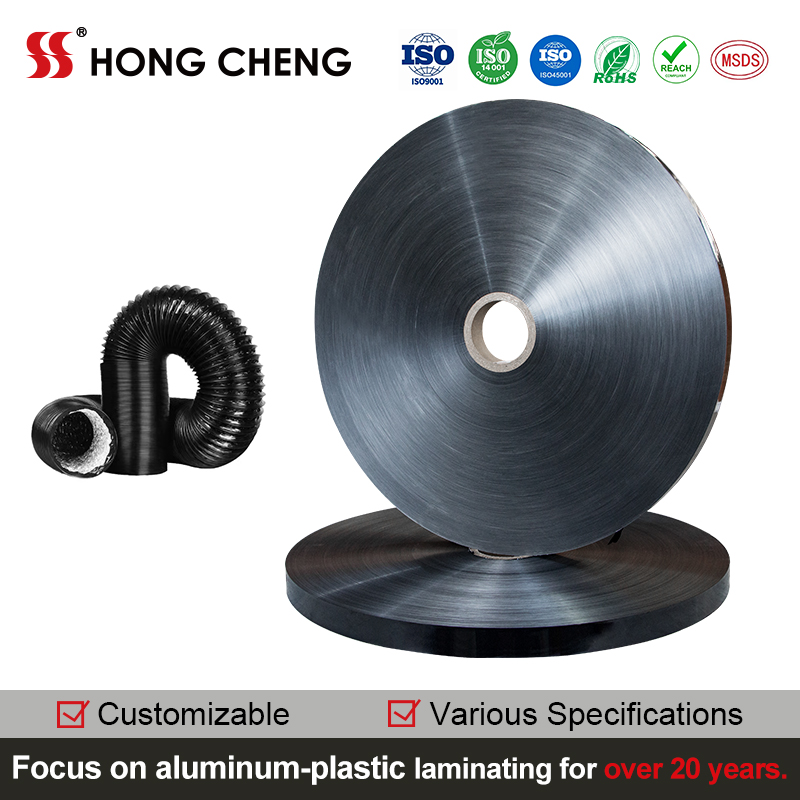
The HVAC flexible duct industry is undergoing a significant material upgrade. Driven by the growing demand for cost-efficient and lightweight solutions in residential and export markets, traditional multi-layer foil composite jackets are increasingly being replaced by a simpler two-layer structure: AL/PE laminated film (aluminum foil + polyethylene laminate). This article examines the performance characteristics, market drivers, and material selection criteria for this growing application.
The Role of the Duct Jacket
The outer jacket of a flexible duct performs three core functions: vapor barrier protection, radiant heat reflection, and physical protection of the inner insulation layer (typically fiberglass or mineral wool). In a standard duct assembly, the jacket wraps around the insulation batting and determines the duct's resistance to moisture ingress, UV exposure, and mechanical abrasion during installation.
Earlier generation products relied on three- or four-layer composites — aluminum foil bonded to fiberglass scrim and polyester film — with basis weights exceeding 90 g/m². While robust, these materials carry a higher cost and weight penalty. As the residential HVAC market has expanded and installation labor costs have risen, manufacturers are shifting toward thinner, lighter AL/PE laminates that still meet the essential performance thresholds.
Structure and Performance of AL/PE Laminate
The standard AL/PE duct jacket laminate consists of two layers: aluminum foil (7–9 μm) + low-density polyethylene (LDPE) extrusion coating (15–25 μm), co-laminated in a single pass without adhesive interlayers. This produces a thin, flexible composite with an excellent foil-to-polymer bond.
Performance Comparison:
| Property | AL/PE Laminate | Foil Scrim Kraft (FSK) |
|---|---|---|
| Basis Weight (g/m²) | 30–55 | 80–120 |
| Thickness (μm) | 25–40 | 100–150 |
| WVTR | Low | Very Low |
| Reflectivity (%) | ≥95 | ≥95 |
| Tensile Strength | Moderate | High |
| Minimum Order | Low | Higher |
The most immediate benefit of the lighter structure is reduced installation burden. A 1,000 m² roll of AL/PE laminate weighs approximately 30–55 kg, roughly half that of an equivalent FSK roll. This matters significantly in high-rise building projects where duct materials must be manually carried through stairwells or vertical shafts.
Market Drivers Accelerating Adoption
1. Residential HVAC Expansion in China
Since 2025, domestic demand for centralized fresh-air systems and kitchen/bathroom exhaust ducting in new residential construction has surged. The performance requirements for residential applications — typically moderate temperatures, low mechanical stress — align well with AL/PE laminate capabilities. The cost savings versus FSK composites can reach 30–40% on a per-square-meter basis, making AL/PE the preferred choice for mid-market developers and OEM duct producers.
2. Export Market Demand in Emerging Economies
HVAC installers across Southeast Asia, the Middle East, and South America are scaling up procurement of flexible duct components. These markets — characterized by high ambient humidity and heat — require moisture-resistant jackets but do not necessarily demand the tensile performance of heavier scrim composites. AL/PE laminates meet the WVTR and reflectivity requirements while offering a favorable weight-to-volume ratio for sea freight, lowering landed costs for importers.
3. Raw Material Cost Pressures
Aluminum prices have remained elevated through 2025–2026. AL/PE composites consume significantly less aluminum per square meter than FSK structures (no scrim, lower foil gauge), translating into meaningful raw material cost savings when aluminum trades above ¥20,000/tonne. Duct manufacturers operating on tight margins increasingly specify AL/PE as the default jacket material unless project specs mandate higher-strength composites.
Key Specification Parameters
When sourcing AL/PE duct jacket laminate, procurement teams should evaluate:
-
Foil Gauge: 7 μm is the recommended baseline for pinhole resistance. Gauges below 6 μm are acceptable only for short indoor runs with minimal mechanical handling.
-
PE Coating Weight: 15 g/m² LDPE is suitable for ambient-temperature applications. For industrial exhaust ducts or environments exceeding 60°C, 20 g/m² or above is preferred to maintain composite bond integrity under heat.
-
Heat-Seal Capability: If the jacket will be used with heat-bonded seam tapes or automated wrapping machines, confirm that the PE layer is heat-sealable grade (LDPE). For manual wrap applications, standard LDPE without heat-seal specification is sufficient.
-
Roll Width Options: Standard duct jacket widths are 600 mm, 900 mm, and 1,200 mm. Custom widths from 200 mm to 1,600 mm are available from Hongcheng Technology to match specific duct diameters and wrapping equipment parameters.
-
Slit Edge Quality: Clean, burr-free slit edges are essential for mechanical wrapping lines to prevent jamming and ensure consistent overlap.
Supply Chain Considerations
AL/PE laminated film for HVAC applications is a mature, well-established product category. Reliable suppliers are concentrated in the Jiangsu-Zhejiang-Shanghai manufacturing corridor. Key sourcing criteria include:
- Foil Source Traceability: Confirm the composite manufacturer sources foil from tier-1 Chinese producers. Foil quality — particularly pinhole count per square meter — directly impacts the laminate's vapor barrier performance.
- Lamination Process: T-die extrusion lamination delivers more consistent coating thickness than older slot-die methods, reducing variation in bond strength across the roll width.
- Quality Documentation: For export orders, request tensile strength test reports (MD and CD directions), aluminum foil adhesion test data, and WVTR certification. ISO 9001 certification is a baseline requirement for most international buyers.
Hongcheng Technology (Hangzhou) manufactures AL/PE duct jacket laminates in a range of configurations: foil gauges from 7 to 12 μm, PE coating weights from 15 to 30 g/m², and total basis weights from 30 to 80 g/m². Custom roll widths and core sizes are available to match OEM duct production requirements. Stable annual capacity supports both spot orders and long-term supply contracts for domestic and international duct manufacturers.
For specifications, samples, or pricing inquiries, please contact: 📞 WhatsApp/WeChat: +86 13758223270 📧 Email: wendy@hcdxcl.com.cn
Warm Edge Tape Materials: Thin-Profile Aluminum PET Composite Film — Technology Trends and Sourcing Guide
High-Temperature Foil Shielding Tape for Motor Lead Wires: What You Need to Know