How to Extend the Service Life of Aluminum Foil Woven Film
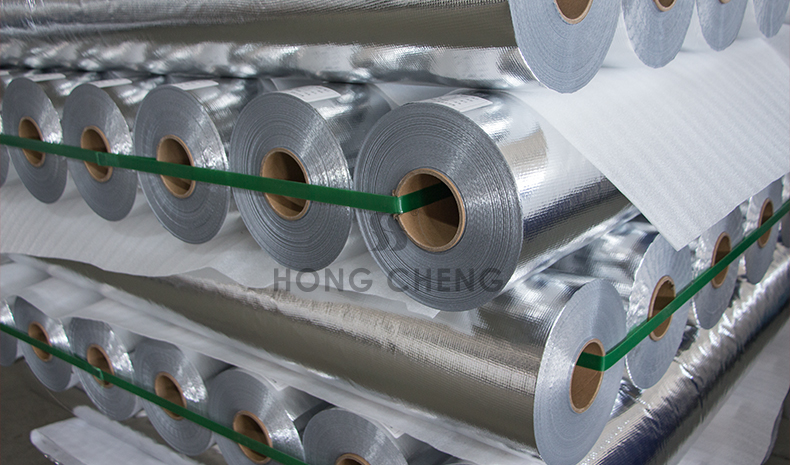
Aluminum foil woven film, with its composite advantages of "aluminum foil thermal insulation and reflection + woven layer tensile resistance," is widely used in building insulation, industrial pipe protection, cold chain transportation packaging, and other fields. However, in its structure, the aluminum foil layer is prone to losing thermal insulation due to oxidation and scratches, while the woven layer (mostly made of PET or glass fiber) is susceptible to corrosion and tensile breakage, leading to overall performance degradation. Scientific maintenance can extend its service life from the conventional 3-5 years to 6-8 years, reducing replacement costs. Below are practical maintenance tips from four dimensions: storage, installation, daily maintenance, and special environment response.
1. Storage: Avoid Basic Damage and Lay a Foundation for Durability
Improper storage is a major cause of early damage to aluminum foil woven film, requiring focus on three key points: temperature and humidity control, stacking method, and scratch/puncture prevention.
Temperature and Humidity Control: Aluminum foil is prone to electrochemical oxidation (white spots or blackening on the surface) when exposed to humid air, and the woven layer is likely to mildew in high-temperature and high-humidity environments. It is recommended to maintain the storage environment at a temperature of 5℃-30℃ and a relative humidity of ≤60%, avoiding proximity to water sources (such as warehouse sinks) or heat sources (such as heating pipes). For long-term storage (more than 3 months), silica gel desiccants (50g per 10㎡ of film) can be placed inside the packaging, and the desiccant status should be checked monthly, with damp desiccants replaced promptly.
Stacking and Load-Bearing: The stacking height of aluminum foil woven film rolls should not exceed 1.5 meters. The bottom layer must be elevated with wooden pallets (at least 10cm above the ground) to prevent moisture penetration from the ground. When stacking, ensure the roll axis is perpendicular to the ground to avoid tilting and squeezing, which can deform the woven layer and wrinkle the aluminum foil—wrinkles easily cause stress concentration, which may lead to cracking during subsequent use. In addition, heavy objects (such as tools and other building materials) are prohibited from being stacked on the rolls to avoid local crushing damage to the aluminum foil layer.
Scratch and Puncture Prevention: Sharp debris (such as nails and gravel) in the storage area should be cleaned up. Before removing the outer packaging (PE film or kraft paper) of the rolls, direct contact with metal tools is prohibited. When taking the rolls, use both hands to lift or special lifting equipment, avoiding dragging one end to prevent edge wear, which affects subsequent cutting and use.
2. Installation: Standardize Operations to Reduce Irreversible Damage
Improper operations during installation (such as excessive stretching and forced bonding) directly shorten the service life of aluminum foil woven film, requiring focus on three key aspects: tension control, bonding method, and edge treatment.
Control Installation Tension: Although the woven layer of aluminum foil woven film has tensile resistance, excessive stretching causes microcracks in the aluminum foil layer (invisible to the naked eye but reducing reflectivity). During installation, a tension controller (especially for pipe winding scenarios) should be used, and the tension value should be controlled within 30% of the breaking strength of the woven layer (e.g., if the breaking strength of the PET woven layer is 500N/25mm, the tension should be ≤150N/25mm). For manual installation, keep the film surface naturally flat and avoid forced stretching and bonding.
Proper Bonding and Fixing: For building insulation or pipe protection, the base surface must first be cleaned (removing dust, oil, and protrusions), and uneven areas of the base should be leveled with putty—protrusions can pierce the aluminum foil layer, and dust affects bonding tightness. When bonding, prioritize the sequence of "from the middle to both ends," and compact with a special pressure roller (hardness 50-60 Shore A) to avoid air bubbles. For fixing, use galvanized nails (to prevent rust contamination) or weather-resistant tape (compatible with the film material, such as PET tape for PET woven film). Ordinary iron nails or acidic tape are prohibited to prevent corrosion of the woven layer or aluminum foil.
Edge and Joint Treatment: The edges of cut film should be sealed with special edge-sealing glue (such as acrylate edge-sealing glue) to prevent moisture from penetrating the woven layer through the cut. Joints should overlap by ≥5cm, and the overlapping area should be fully covered with weather-resistant tape (width ≥8cm) to avoid cracking at joints due to thermal expansion and contraction—especially in outdoor or high-temperature scenarios (such as industrial pipes), unsealed joints will show aluminum foil oxidation and woven layer weathering within 1-2 years.
3. Daily Maintenance: Regular Inspection and Timely Repair of Minor Damage
The core of daily maintenance is "early detection and early repair" to prevent small damages from expanding into major failures. Inspection frequencies and repair plans should be formulated based on scenarios.
Regular Inspection Cycle: For building roofs or exterior walls, inspections are recommended quarterly (focusing on after heavy rains and strong winds); for industrial pipe protection, monthly inspections (especially near heat sources or acid-base areas); for cold chain transportation packaging, inspections are required after each transportation (to avoid punctures during loading and unloading). During inspections, focus on: whether the aluminum foil layer has scratches or white oxidation spots, whether the woven layer is damaged or moldy, and whether joints are cracked or tape is peeling.
Minor Damage Repair Tips: For aluminum foil scratches with a diameter of ≤5mm, use aluminum foil repair tape (same thickness as the original film) to cover, with edges exceeding the damaged area by ≥2cm, and no air bubbles after compaction. For local damage to the woven layer (without damaging the aluminum foil), first clean the dust at the damaged area, then cover with woven fabric of the same material (cut into a circle with a diameter ≥3 times the damaged area), and bond with compatible glue on the back. For cracked joints or peeling tape, remove the old tape, clean the dirt at the joint, re-bond with overlap, and replace with new weather-resistant tape—adding new tape directly on old tape is prohibited, as poor tightness will cause secondary cracking.
Cleaning Precautions: When the film surface is contaminated with dust or light oil, wipe gently with a soft cloth (such as suede cloth) dipped in clean water or neutral detergent (such as detergent solution with pH 7-8). Hard brushes, steel wool, or acidic detergents (such as hydrochloric acid and oxalic acid) are prohibited to avoid scratching the aluminum foil or corroding the woven layer. For excessive dust accumulation on outdoor film surfaces, a low-pressure water gun (water pressure ≤0.3MPa) can be used for flushing, with the water flow at a 45° angle to the film surface to avoid vertical impact loosening joints.
4. Special Environment Response: Targeted Protection Against Extreme Effects
In special environments such as humidity, high temperature, and acid-base conditions, additional protective measures are needed to resist accelerated erosion of the film by the environment.
Humid and High Salt Spray Environments (such as underground garages and coastal buildings): In addition to regular sealing, a PE moisture-proof film (thickness ≥0.12mm) should be installed on the outer side of the film, or weather-resistant protective agent (such as silane-based protective agent) should be sprayed regularly (every 6 months) to enhance the aluminum foil's oxidation resistance. For outdoor applications in coastal areas, woven layers with anti-salt spray additives (such as glass fiber woven layers with titanium dioxide) should be selected, and the aluminum foil reflectivity should be tested every 2 years. Local replacement is required when reflectivity is below 70%.
High Temperature and Strong UV Environments (such as around industrial kilns and outdoor roofs): A sunshade net should be installed on the film surface (especially in summer) to reduce the aging effect of high temperature on the woven layer. UV-modified aluminum foil woven film (such as aluminum foil layer coated with UV blockers) should be selected, and the film surface should be checked quarterly for discoloration (such as yellowing and brittleness). Discolored areas should be replaced promptly to avoid chain degradation of overall performance.
Acid-Base Corrosion Environments (such as chemical workshops and electroplating plant pipes): Ordinary aluminum foil woven film is prohibited for direct use; corrosion-resistant modified products should be selected (such as PP woven layers and aluminum foil layers coated with fluorocarbon coatings). Daily contact with acid-base solutions should be avoided; if accidentally contaminated, rinse immediately with clean water and dry, and test the film surface residue with pH test paper regularly (monthly) to ensure no acid-base residue.
In conclusion, the durability of aluminum foil woven film depends not only on product quality but also on scientific maintenance to maximize its performance and service life. The core principle is "prevention first and targeted protection"—avoid damage risks based on differences in storage, installation, and usage scenarios, and conduct regular maintenance and repairs to allow aluminum foil woven film to continuously play its role in thermal insulation and protection, reducing long-term operating costs for construction, industry, transportation, and other fields.
How to Select Vacuum Aluminum Foil Composite Films for Pallets/Wooden Cases?
Glass Fiber Aluminum Foil