Thin-Profile AL/PET Shielding Tape Selection Guide for High-Speed Data
Cables (HDMI / USB / DisplayPort)
As consumer electronics and automotive displays evolve rapidly, high-speed interfaces such as HDMI 2.1, USB4, and DisplayPort 2.0 have become standard features across smartphones, laptops, monitors, and vehicle infotainment systems. These interfaces push data rates from 10 Gbps up to 40 Gbps and beyond — a leap that places extraordinary demands on cable shielding materials. For procurement teams at cable manufacturing companies, selecting the right thin-profile AL/PET shielding tape (also called aluminum mylar tape or thin-profile aluminum polyester laminated foil) directly affects the finished cable's EMI shielding effectiveness, bending endurance, and production cost.
Why High-Speed Data Cables Demand Better Shielding Foil
High-speed data cables operate at frequencies far beyond traditional control cables. HDMI 2.1 runs at 12 Gbps per channel (48 Gbps across four channels). USB4 Gen 3×2 achieves 40 Gbps bidirectional. DisplayPort 2.0 reaches 80 Gbps in UHBR20 mode. At these frequencies, differential signal pairs are exquisitely sensitive to electromagnetic interference — even minor radiation leakage or external noise ingress can cause packet loss, frame tearing, or link-rate fallback.
This is why each differential pair inside a high-speed cable requires an individual foil shield wrapped around it — known as "pair shielding." The shielding material must satisfy three core requirements: near-100% coverage (gaps or pinholes become leak windows), minimal thickness (to fit multiple pairs in a compact cable cross-section), and sufficient flexibility (so the shield does not crack when the cable is repeatedly flexed).
Structure and Technical Logic of Thin-Profile AL/PET Laminated Foil
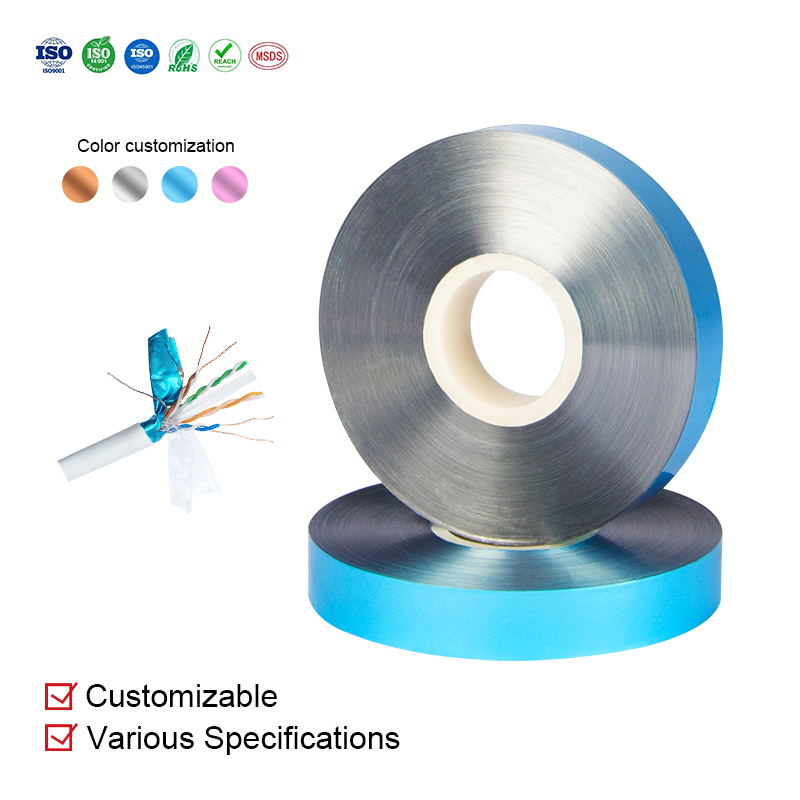
Thin-profile AL/PET shielding tape consists of two functional layers bonded together: an aluminum foil layer that provides electromagnetic reflection and attenuation, and a PET (polyester film) layer that supplies mechanical support and electrical insulation. Typical constructions use 6–9 μm aluminum foil laminated to 12–25 μm PET, yielding total thicknesses in the 18–34 μm range.
Aluminum foil layer: The foil is the core shielding element. Its primary mechanism is reflection — incident electromagnetic waves induce mirror currents on the foil surface, bouncing most radiated energy back toward the source. When foil thickness decreases from 7 μm to 6 μm or even 4.5 μm, DC conductivity drops somewhat. However, for signals above 1 MHz, the skin effect ensures that shielding effectiveness is dominated by surface conductivity, meaning thin-profile foil still maintains ≥40 dB shielding attenuation.
PET layer: PET film does not contribute to shielding, but it serves two critical functions. First, it prevents the aluminum foil from tearing during cable twisting and foil-wrapping operations. Second, it provides electrical insulation, ensuring the shield cannot short-circuit with the signal conductors. PET thickness must be balanced — too thin, and the foil lacks support, cracking under bend stress; too thick, and overall tape thickness increases, crowding the cable's internal geometry.
Five Key Parameters for Procurement Selection
When sourcing thin-profile AL/PET shielding tape for high-speed data cables, procurement teams should verify these five parameters:
1. Foil Thickness and Uniformity Prioritize 7 μm or 6 μm aluminum foil substrates. Thickness uniformity deviation should be ≤±0.5 μm. Non-uniform foil creates shielding effectiveness fluctuations — locally thin zones become weak points for signal leakage. While 4.5 μm ultra-thin foil offers maximum thinness, it demands higher process maturity from both the laminator and the cable wrapper; confirm the supplier's process capability before committing.
2. Lamination Bond Strength The bond between aluminum foil and PET must be robust. Peel strength should be ≥2.0 N/25mm. Poorly bonded laminated foil will delaminate during wrapping — the foil and PET curl independently, leaving shield gaps and insulation voids that compromise both cable performance and appearance.
3. Bend Fatigue Resistance High-speed data cables (especially USB Type-C) undergo frequent plug/unplug cycles. The shielding tape must endure repeated flexing without cracking. Request bend fatigue data from the supplier — a common benchmark is 500+ reciprocating bends with no visible foil cracks. PET thickness significantly affects this metric; a balanced 12 μm PET + 7 μm aluminum foil construction typically meets bend requirements for most data cables.
4. Surface Resistance and Shielding Effectiveness The foil's surface resistance (sheet resistance) directly governs shielding effectiveness. 7 μm foil typically measures 0.3–0.5 Ω/sq; 6 μm foil ranges 0.5–0.8 Ω/sq. Lower sheet resistance yields higher SE. Procurement teams should request measured shielding attenuation values (Shielding Effectiveness, SE) — SE ≥40 dB at 1 GHz is a qualified baseline for high-speed data cable applications.
5. Slit Width and Roll Diameter Compatibility Pair shielding in data cables typically uses narrow-width foil wrapping, with slit widths from 6 mm to 30 mm. Confirm the supplier's narrow-width slitting capability — slit edges must be clean and burr-free. Burrs can puncture insulation layers during wrapping, causing pair-to-pair shorts. Roll diameter must match the wrapping machine specification; 76 mm (3-inch) inner diameter is the industry standard.
Common Selection Pitfalls and Corrections
Pitfall 1: "Thicker foil shields better." In reality, high-frequency shielding effectiveness is dominated by surface conductivity. The difference between 7 μm and 15 μm foil at frequencies above 1 GHz is negligible. Excessively thick foil reduces flexibility, increases bend-crack risk, and wastes cable cross-section space.
Pitfall 2: "Focus on price, not consistency." Low-bid laminated foil may suffer from foil thickness variability and unstable bond strength. High-speed data cables demand shielding consistency — if some cables in a batch fail EMI testing, rework costs far exceed the material savings.
Pitfall 3: "Thinner PET saves money." Insufficient PET thickness dramatically increases foil bend-crack rates, dragging down cable yield. An appropriate PET thickness is prerequisite for bend endurance; 12–19 μm PET paired with 6–7 μm foil is the mainstream specification range for data cable shielding.
Hongcheng Technology's Thin-Profile AL/PET Shielding Tape Solution
Hangzhou Hongcheng Technology Co., Ltd. has specialized in aluminum foil composite materials for over a decade. Thin-profile AL/PET shielding tape is one of the company's flagship products for the high-speed data cable market. Key product features include:
- Aluminum foil thickness options: 4.5–9 μm, with 7 μm and 6 μm as mainstream choices for data cable shielding; thickness uniformity deviation ≤±0.5 μm
- PET substrate thickness: 12–25 μm, customizable to balance flexibility and support strength
- Lamination peel strength ≥2.0 N/25mm, ensuring no delamination during wrapping operations
- Narrow-width slitting: 6–30 mm, clean edges free of burrs, compatible with all pair-wrapping equipment
- Measured sheet resistance: 0.3–0.8 Ω/sq, shielding attenuation ≥40 dB at 1 GHz
The company supports custom specifications for foil thickness, PET thickness, slit width, and roll diameter based on the customer's cable construction. Sample testing and small-batch pilot production services are available. From material selection to volume supply, Hongcheng Technology is committed to providing cable manufacturers with stable, consistent, and cost-effective shielding material solutions.
Contact: +86 13758223270 Email: wendy@hcdxcl.com.cn
Summer Heat Drives HVAC Duct Upgrades: A Guide to VMPET Metalized Film Duct Facing
Export Equipment Vacuum Packaging: How Aluminum Foil Woven Fabric Laminate Protects Heavy Machinery on Long-Haul Sea Routes