Thin-Profile AL/PET Composite Shielding Film for High-Speed Data Cables: A Material Selection Guide for HDMI, USB & DisplayPort Applications
As HDMI 2.1, USB4, and DisplayPort 2.1 become standard interfaces across consumer electronics, professional AV systems, and automotive infotainment, electromagnetic compatibility (EMC) management inside data cables has never been more demanding. With signal frequencies now routinely reaching 10 GHz and beyond, cable designers face a fundamental challenge: how to achieve adequate shielding effectiveness without sacrificing flexibility, outer diameter control, or production efficiency.
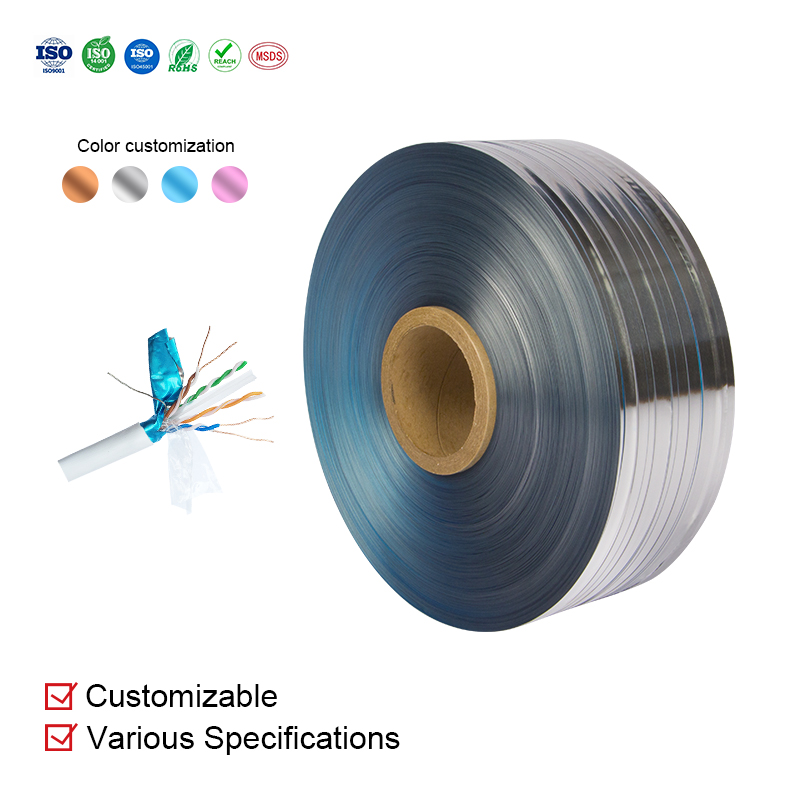
Thin-profile AL/PET composite shielding film — aluminum foil laminated to a polyester (PET) substrate — has emerged as the go-to solution for HDMI, USB-C, and DP cable manufacturers worldwide, and is increasingly being adopted in industrial camera cables, medical imaging links, and aerospace entertainment system wiring.
Structure Overview: Three Main Types
① Single-face AL/PET (aluminum + PET film) Aluminum foil thickness typically ranges from 6 to 9 microns, bonded to a 12–25 micron PET film, yielding a total laminate thickness of 18–34 microns. The aluminum layer can face inward or outward depending on design preference. Suitable for standard USB-A, conventional HDMI, and moderate-speed data cables.
② Double-face AL/PET/AL (aluminum / PET / aluminum) Aluminum foil on both surfaces provides 360-degree shielding closure. Total thickness is approximately 30–50 microns. Preferred for USB4, HDMI 2.1 at 48 Gbps, DisplayPort 2.1, and medical-grade cables where both sides must be shielded against external interference.
③ Metalized type (vacuum-deposited aluminum on PET) A nano-scale aluminum layer (approximately 35–60 nm) is vapor-deposited onto a PET substrate, resulting in a total laminate as thin as 12–16 microns with minimal weight. Shielding effectiveness is slightly lower than rolled-foil constructions, making this format best suited for ultra-fine cables or flexible/bendable designs where weight and bend radius are critical.
Four Design Trade-offs Every Cable Engineer Should Know
1. Foil Thickness vs. Shielding Effectiveness Thicker aluminum provides higher reflective loss at low frequencies but increases cable outer diameter and reduces flex life. For consumer-grade HDMI 2.1 cables subject to frequent plugging and unplugging, foil thickness is typically held at 6–7 microns, paired with a 12–16 micron PET film, to optimize the balance between performance and cable dimensions.
2. Overlap Width vs. Coverage Continuity During spiral wrap application, overlap percentage directly affects shielding continuity. An overlap below 10% creates signal leakage at seams, measurably increasing bit error rate (BER). Excessive overlap wastes material and increases outer diameter. Achieving consistent overlap relies heavily on slit-width precision — tolerances of ±0.1 mm or better are recommended for automated wrapping lines.
3. Bond Strength vs. Flex Life USB cables destined for consumer markets typically undergo thousands of bend cycles per IEC 62368-1 or brand-specific internal test standards. Peel strength between the aluminum foil and PET substrate should be at least 1.0 N/15 mm to prevent delamination and foil cracking under repeated flexing.
4. Surface Resistance vs. Grounding Reliability In shielded cable designs where the foil layer is electrically connected to a drain wire or copper tape for grounding, surface resistivity of the aluminum face should be ≤ 0.05 Ω/sq. Higher resistivity impairs ground continuity and reduces low-frequency shielding effectiveness.
Standard Specification Comparison
| Grade | Foil Thickness | PET Thickness | Total | Typical Use |
|---|---|---|---|---|
| Standard single-face AL/PET | 9 μm | 12 μm | ≈21 μm | USB-A 2.0/3.0, HDMI 1.4 |
| Thin-profile single-face AL/PET | 6 μm | 12 μm | ≈18 μm | HDMI 2.0/2.1, USB-C |
| Ultra-thin single-face AL/PET | 6 μm | 6 μm | ≈12 μm | Ultra-fine cables, flex cables |
| Double-face AL/PET/AL | 6+6 μm | 12 μm | ≈24 μm | USB4, DP 2.1, pro imaging |
| Metalized (vapor-deposited) | ≈50 nm Al | 12 μm | ≈12 μm | Ultra-light, foldable cables |
Key Parameters to Verify Before Purchasing
Procurement teams at cable manufacturers should request documentation for the following five parameters before placing orders:
- Foil thickness report: Per-batch measured foil thickness (μm) with a tolerance of ±0.5 μm or better.
- Peel strength: T-peel test per GB/T 8808 or ASTM D903; minimum 1.0 N/15 mm is the standard acceptance threshold.
- Pinhole count: Foil pinholes compromise high-frequency shielding. Request supplier test data or accept sample verification testing.
- Slit-width tolerance: For automated wrapping, slit width tolerance should be ≤ ±0.1 mm with clean, burr-free edges.
- Customization capability: Confirm whether the supplier supports custom widths, reel core diameters (75 mm / 100 mm inner diameter), aluminum face orientation (inward/outward), and small trial order quantities.
Market Outlook
The global market for thin-profile AL/PET shielding film in high-speed data cables is expected to grow steadily through 2026–2028, driven by three converging factors: the ongoing HDMI 2.1 and USB4 upgrade cycle in the PC and display industries; the rapid expansion of in-vehicle infotainment and ADAS cable harnesses in new energy vehicles; and the scaling of high-bandwidth internal interconnect cables inside AI data centers.
All three markets demand tighter dimensional tolerances, higher shielding performance, and greater supply-chain consistency from foil laminate suppliers than previous generations of cable designs. This creates a clear opportunity for manufacturers that can reliably supply thin-profile AL/PET composite film to these exacting specifications.
Hongcheng Technology supplies customized AL/PET shielding laminates with aluminum foil thickness options from 6 to 12 microns, in single-face, double-face, and metalized structures. Custom slitting widths, reel dimensions, and composite configurations are available. Contact us for samples and technical consultation.
FS Structure Aluminum Foil Scrim Laminate: A Lightweight Facing Solution for HVAC Duct Applications
AL/PE Composite Lining Film for Bags & Cases: Market Trends and Material Selection Guide