AL+PET+PET Triple-Layer Shielding Tape: The Invisible Armor Inside Every Data Cable
1. First, Know the Structure
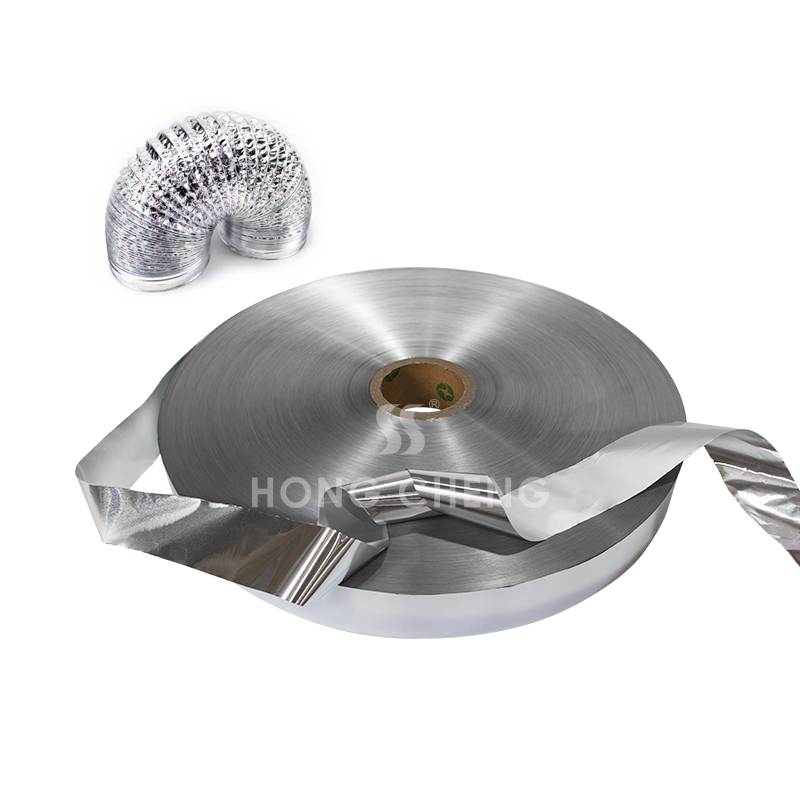
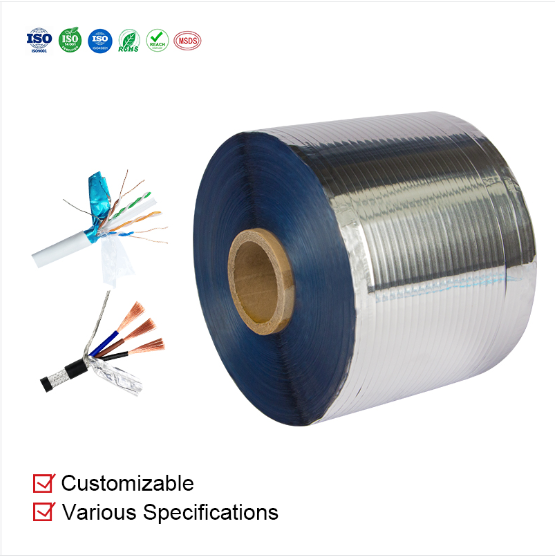
In any cable factory warehouse, this product appears as a large roll: paper core inside, one face evenly blue, the other face bright silver. Zoom into the cross-section and you find three layers from inside out: aluminum foil (AL), a PET film, and a second PET film — the classic AL+PET+PET construction.
Each layer has a distinct job.
The aluminum foil layer is the heart of the material, typically 6–9 microns thick. Aluminum is an excellent conductor, and it performs the actual electrical work of shielding — reflecting and draining external electromagnetic interference, and containing the signal energy trying to leak out of the cable. Reducing foil thickness by one micron cuts cost noticeably, but pinhole rate and mechanical strength both deteriorate. It is a parameter that must be balanced with precision.
The first PET layer sits directly on the foil and carries three responsibilities: tensile strength (bare foil is far too brittle for high-speed wrapping without PET backing), insulation (keeping the shield from shorting against the conductors), and serving as the carrier face for lamination.
The second, outer PET layer is usually dyed — which is why the tape is blue. Blue is not an aesthetic choice but an industry convention: the colored face goes outward, allowing operators to visually verify wrap direction and overlap condition on the line. The pigmented PET also provides a more abrasion-resistant outer surface, protecting the aluminum from scratching during wrapping. Some customers specify other colors to distinguish batches or specifications.
2. What It Actually Shields Against
Interference in a data cable comes from two directions, and the tape must handle both.
External interference. Network cables often run parallel to power lines for tens of meters inside conduits, trays and walls. Mains hum, high-frequency switching noise, and crosstalk from neighboring cables all couple into the signal pairs. The foil layer, acting as an equipotential conductor, routes these interference currents into the grounding path and restores a clean electromagnetic environment around the conductors.
Self-emission. Fast differential signals are themselves interference sources, radiating outward and disturbing adjacent cables in the same tray. The shield contains this energy too — which becomes critical at 10-Gigabit speeds (Cat6a and above) and in PoE-powered systems.
The core performance metrics are shielding attenuation and transfer impedance. Whether these are met in practice depends less on the foil itself than on an easily overlooked detail: electrical continuity at the overlap. During wrapping, the blue face and the aluminum face must form a reliable electrical bond; otherwise the shield is electrically open, and the datasheet numbers are meaningless. This is the single largest difference between cable-grade composite tape and ordinary foil-PET laminates — the lamination process must be engineered with the overlap bond in mind.
3. Why Three Layers Instead of Two
Two-layer AL+PET products do exist on the market, at lower prices. For data cables, however, the third layer earns its keep in three ways.
First, mechanical redundancy. On a high-speed wrapping machine, the tape is pulled, turned, wrapped and cut at several hundred meters per minute. With a two-layer construction, the slightest pinhole in the foil combined with higher wrap tension means a break and a line stop. The double PET construction widens the usable tension window and reduces downtime — and for a cable plant, saved uptime is worth more than the material price difference.
Second, electrical stability. With the foil fully encapsulated between PET layers, it cannot be punctured by direct contact with conductors or during jacket extrusion, so shielding performance does not degrade over the cable's life.
Third, manufacturing freedom. With the color layer and the insulation layer separated, color and thickness can be adjusted independently. When a customer requests "a specific blue + a specific total thickness + a specific foil grammage," the parameters no longer need to trade off against each other.
4. How a Good Tape Is Made
The three-layer build is typically produced in two stages — foil laminated to the first PET, then bonded to the second — using extrusion lamination or hot-melt adhesive layers. Four control points dominate quality.
Lamination flatness. Bubbles or wrinkles during foil-PET bonding show up as visible "cloud patches" on the roll and cause local lifting during wrapping. Full-line, zone-by-zone tension control is essential.
Peel strength. Insufficient interlayer bond causes edge delamination and aluminum powdering during slitting. Powder contaminates the line, and loose aluminum particles adhering to conductors are a latent defect.
Slitting quality. Tape is delivered in various widths; cut edges must be smooth and burr-free. Burrs puncture the PET layer during wrapping.
Static and cleanliness. PET surfaces attract dust easily; cleanliness control in production and packaging directly shapes the downstream experience.
Hangzhou Hongcheng Technology Co., Ltd. has mature process experience in the extrusion lamination of aluminum foil, PET and other substrates. Our shielding tape products comply with RoHS and REACH requirements and are produced under certified ISO management systems. Width, total thickness, foil grammage and color can all be customized, and sampling through volume delivery is matched to each cable plant's actual line parameters.
5. Applications Beyond the LAN Cable
Although data cable is its most familiar home, the application map of AL+PET+PET tape is wider than expected:
- Data cables: overall or pair shielding for Cat5e/Cat6/Cat6a, shield layers for coaxial cable;
- Telecom cables: metallic barrier layers for telephone and composite fiber cables;
- Electronic wires: wrap shielding for USB, HDMI and other high-speed transmission lines;
- Specialty cables: modified heat-resistant constructions for robot cables and auxiliary shielding in EV high-voltage harnesses.
Wherever "high-speed signals meet a noisy electromagnetic environment," this blue film has a place.
6. Conclusion
A network cable sells for a few dozen yuan and carries the connectivity of an entire server room. On the bill of materials, AL+PET+PET shielding tape occupies a single small line item — yet it decides whether the finished cable passes transmission testing. Small material, serious selection. For samples or custom specifications, contact us anytime.
Contact
- Company: Hangzhou Hongcheng Technology Co., Ltd.
- Tel: +86 13758223270
- Email: mark@hcdxcl.com.cn
- Main products: Aluminum foil, aluminum foil woven fabric, metallized film, kraft paper, non-woven and other laminated composites
- Applications: Cable and electronic shielding, flexible ventilation ducts, building thermal insulation, packaging
- AL+PET+PET shielding tape: custom width / thickness / grammage / color, RoHS & REACH compliant — samples available on request
Choosing Shielding Tape for Motor Lead Wires: Four Motor Types, Four Decisions
FIBC Liner Film Purchasing: 5 Traps Every Bulk Bag Maker Should Avoid