Duct Foil Costing: Get the Aluminum Gauge and Laminate Ratio Right First
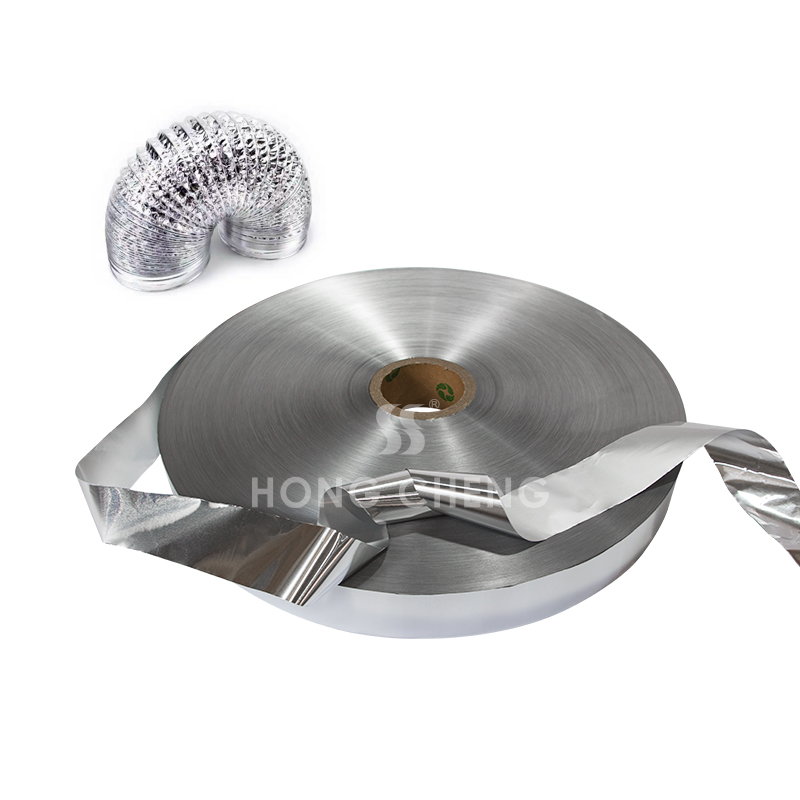
A familiar scene at flexible duct factories: two suppliers quote prices roughly ten percent apart. The samples match on grammage, width, and surface appearance. Procurement picks the lower price. Six months later, the cost savings have quietly disappeared.
The gap sits in two numbers — how much aluminum is in the foil layer, and how the laminate is balanced. Both drive material cost per square meter, yet quotations usually state only total grammage, which hides the breakdown. Understanding those two numbers is worth more than another round of price negotiation.
First number: aluminum gauge is neither "thicker is better" nor a free variable
The aluminum layer is the only part of a duct foil that actually reflects radiant heat and blocks moisture. Conventional supply runs from 6μm to 9μm: 6μm as the thin grade and 9μm as the heavy grade. Each step up increases aluminum consumption per square meter, and that is the hardest cost component in the structure.
What procurement actually has to decide is which grade the project needs.
For ambient-temperature supply duct, modest diameters, and flexible duct that is not repeatedly compressed after forming, 6μm is enough. The aluminum here handles reflection and vapor blocking, not tensile load — the PET or PE layer carries the mechanical duty.
For main supply and return duct in air-conditioned systems, air-handling unit sections, and composite duct that gets secondary fabrication on site, move up to the heavy 9μm grade. The extra aluminum is margin for folding and flanging. The same film that shows almost no pinholes when laid flat will develop micro-perforations along a fold line after two bends.
For high-pressure supply, embossed or deep-drawn surfaces, and continuous negative-pressure service, move to the 9μm heavy grade. Saving aluminum here simply transfers the cost to customer complaints later.
One detail that gets overlooked: as the aluminum gets thinner, the laminate process matters more than the foil itself. Thin foil is far more sensitive to adhesive coat weight uniformity and curing conditions. A formulation that runs cleanly on the heavy grade may not be stable on the thin grade. So "thicker equals upgraded" is not a safe assumption either — ask how much production experience the supplier has at that specific gauge.
Second number: laminate balance is where cheap film saves money
Two films with identical total grammage can differ significantly in price. The difference is how the grammage is distributed.
Take an example. A 6μm aluminum layer weighs roughly 16g/m² on its own. An AL/PET laminate quoted at 90g/m² total therefore gives 16g to aluminum and 74g to PET and adhesive. Adding 10g of total weight to the aluminum improves barrier performance; adding the same 10g to the PET improves stiffness and tensile strength. Completely different outcomes from the same number on the datasheet.
So the question at quotation is not "how many grams" but "how are those grams split."
Three figures settle it: aluminum gauge, PET or PE layer grammage, and adhesive coat weight. A supplier who quotes all three is offering a transparent cost structure. A supplier who quotes only total grammage is keeping room to move.
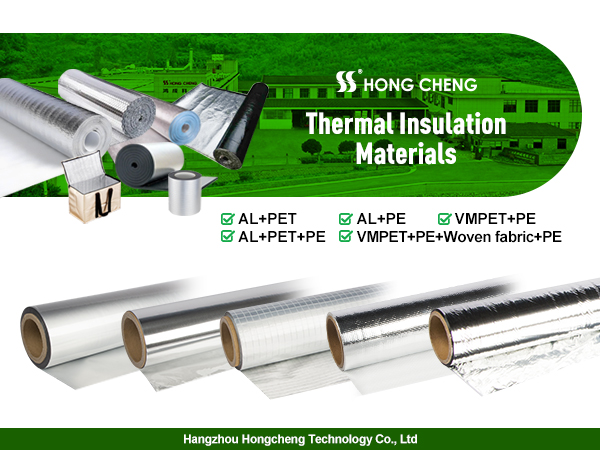
There is a less obvious substitution as well: replacing the foil layer with metallized VMPET. VMPET carries a vacuum-deposited aluminum layer measured in nanometers, with negligible weight. It looks bright and its reflectivity is respectable, but barrier performance, flex resistance, and conductivity are not in the same class as solid foil. If a quotation says "AL" while pricing like VMPET, the difference will not show in incoming inspection. It shows up later as moisture reversion and delamination on site.
How these two numbers translate into buying decisions
A simple order of operations.
Fix the application first, then the aluminum gauge. Supply duct, return duct, and exhaust duct place different demands on barrier and flex resistance. Narrow the gauge within the 6μm to 9μm range by application. Do not work backwards from price and ask how thin the foil can be — that path usually ends at the specification floor.
Then set the laminate structure by forming method. Hand-layup operations tolerate lower film stiffness, so PET grammage can come down. High-speed machine forming subjects the film to tension and guide-roller abrasion, and the PET or PE layer cannot be reduced without paying for it in web breaks and downtime, which costs far more than the material differential.
Only then discuss price. At the end of a price discussion, only two variables remain: drop the aluminum one grade, or trim a few grams from the laminate. Both should be signed off by the buyer, not left to the supplier's discretion.
Two questions that keep quotes honest
Two verification habits keep the numbers honest through the whole negotiation. First, ask the supplier to break the quotation into layer-by-layer grammage on the datasheet itself, not in a separate email. A supplier who routinely structures quotations this way is easy to compare against competitors, because every line item sits in the same place. Second, weigh a cut sample. A 100mm by 100mm swatch on a 0.01g balance, with the aluminum and adhesive layers estimated from known gauge weights, will reveal within minutes whether the claimed split is real. Neither test requires laboratory equipment, and both can be repeated on every incoming batch, which is precisely what makes them useful over a long supply relationship. Buyers who adopt these two habits typically find that quotation quality improves across their whole supplier base within one or two order cycles, because every supplier learns that vague grammage figures no longer pass unnoticed.
A counterpoint worth keeping
Not every application should move upward. For short branch duct, special fittings, and one-time packaging duct, adequate is adequate. These products have short service lives; specifying 9μm with heavy PET adds cost the customer will not pay for, and the stiffer film actually makes forming harder.
The test is straightforward: in what environment will this film end up, for how long, and through how many processing steps. Answer those three and the gauge and ratio choose themselves.
Hangzhou Hongcheng Technology specializes in aluminum foil laminates and PE extrusion coatings. AL/PE duct foil, VMPET duct foil, and single- or double-sided foil laminates are supplied to order by aluminum gauge, laminate structure, and width.
+86 13758223270 Email: wendy@hcdxcl.com.cn
Techfoil
Thermal Bag Foil Laminate: Five Procurement Pitfalls Insulated Bag Manufacturers Should Avoid
Why Heat Trace Shielding Tape Changes With Every Installation