After the Panels Go Up: Three Shifts in Waterproofing Membrane Selection for PV Roofs
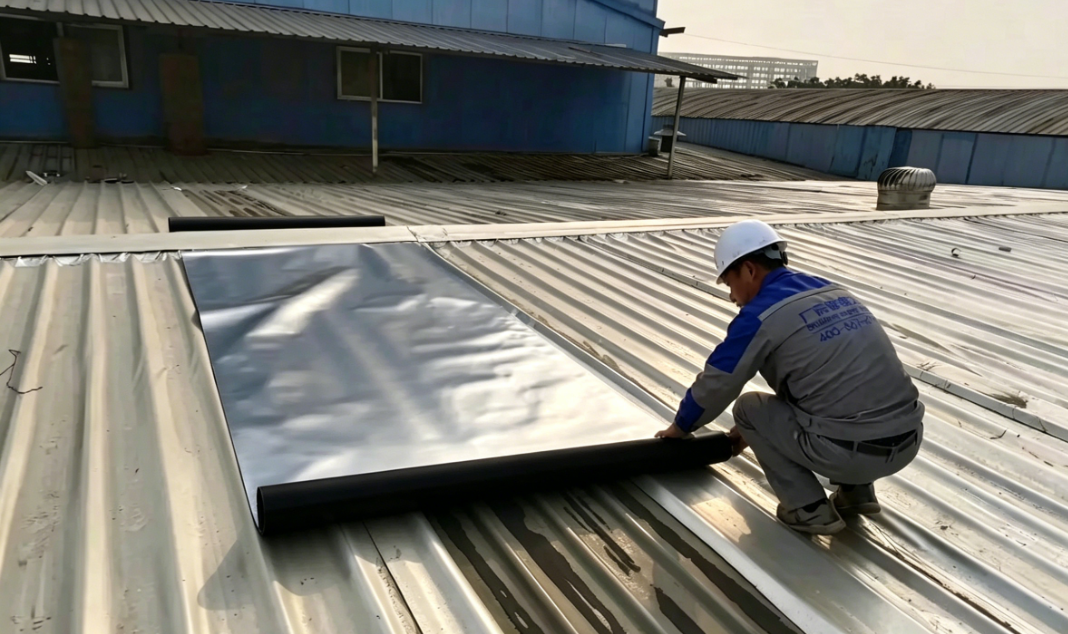
When distributed solar moves onto an industrial roof, the first thing that changes is rarely the power design — it is the waterproofing layer underneath. The roof now carries a layer of modules whose backsheets run noticeably hotter than the surrounding air under load, and that heat conducts straight into the membrane below. Stands and rails consume part of the drainage path, so water lingers longer in low spots. Inspection, cleaning and foot traffic all increase compared with a plain flat roof. Specifications written for an ordinary roof start failing on these roofs — not by leaking immediately, but by blistering first, then delaminating, and finally seeping at the lap seams.
We supply aluminum-plastic film rolls to waterproofing membrane manufacturers and insulation product makers; we do not install roofs. Over the past two quarters, the enquiries coming back from downstream membrane plants show three clear shifts that any converter now quoting PV roof work should recognise.
Shift one: from "does it look bright" to "show me the numbers"
Not long ago, a request for a reflective aluminum-plastic film came with a single question: is the surface a mirror-like silver? Increasingly, membrane plants now ask for solar reflectance and normal emittance figures together, because project owners must report both in energy calculations.
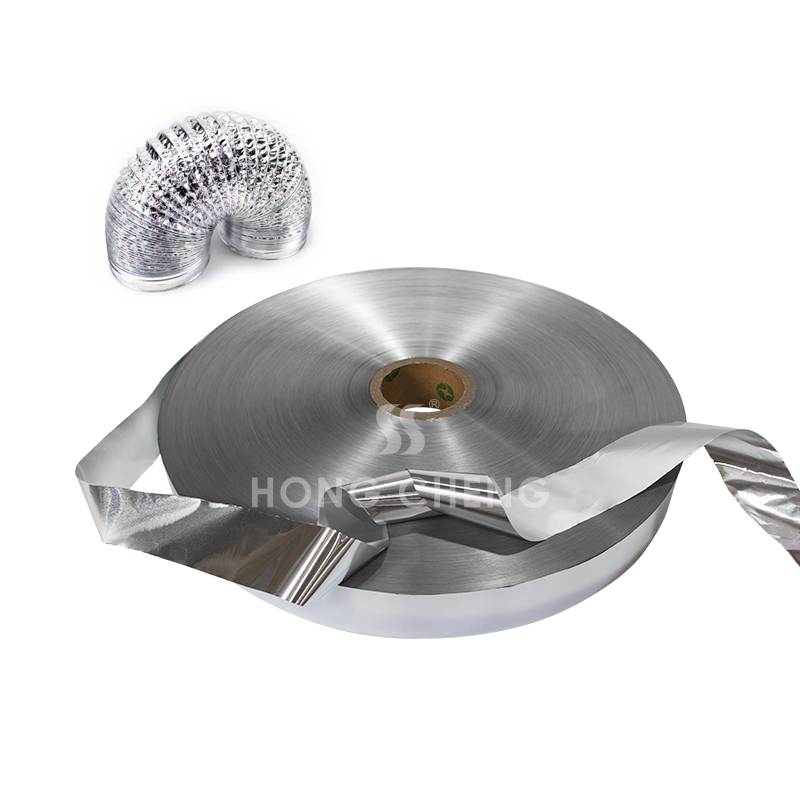
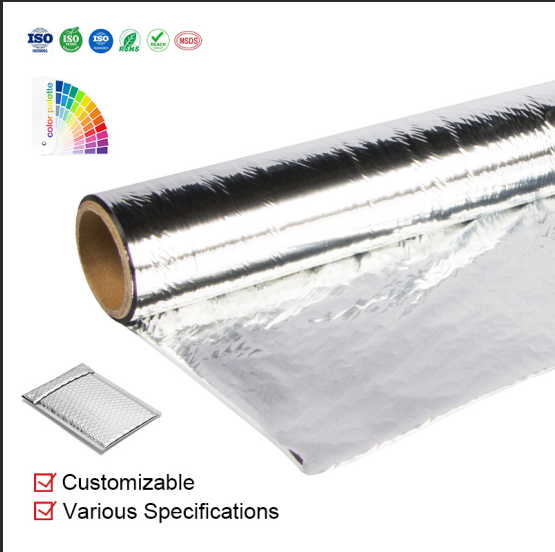
This point deserves clarity: reflectance in an aluminum-plastic film comes from the aluminum layer itself, not from surface gloss. Pure foil structures such as AL/PE and PET/AL/PE typically achieve high reflectance. A metallized VMPET/PE laminate can look equally bright — sometimes more uniform to the eye — but its aluminum is a vacuum-deposited layer measured in nanometres, and its reflectance is not in the same class as solid foil. Under prolonged hot and humid service the deposited layer can also degrade gradually. The two are hard to tell apart by eye at goods-in.
The practical response is to write reflectance into the contract as a measured value, agree the test method, and verify by batch sampling. Add one parameter that is often omitted: normal emittance. A high reflectance with an unsuitable emittance limits night-time heat dissipation, and roof temperature swings stay wider than expected.
Shift two: aluminum gauge moves from one grade fits all to zone-by-zone
A PV roof membrane is not laid at one specification throughout. The area shaded by modules, the walkways between arrays, the edge upstands, gutters and parapet terminations each see very different service conditions.
Directly beneath the modules is the hottest and least ventilated zone. For this band we recommend the heavy 9μm aluminum grade in a PET-bearing structure. One grade up reduces pinhole count and gives better long-term stability of both barrier and reflectance at elevated temperature, while the PET layer provides the stiffness to resist local compression during stand installation. Conventional supply runs 6μm to 9μm, with 9μm as the heavy grade — there is no reason to quote beyond that range, and buyers should instead concentrate on pinhole rate and bond strength, the two figures that can actually be verified.
Exposed walkways and areas subject to repeated foot traffic need mechanical protection on top of the same aluminum grade. Many converters specify an AL/PET/PE or heavier-PET three-layer structure with a thicker PE layer, relying on the soft base layer to absorb deformation from footfall so the aluminum does not crack at repeated fold lines.
Gutters and parapet terminations are the opposite case: the thin 6μm grade suits them better. Details are cut, folded and hot-air welded by hand. A film that is too stiff will not produce a tight, conforming termination, and trapped air at corners follows directly. A thinner, more supple film makes workmanship quality far easier to hold. This runs against the intuition that thicker is always better.
Shift three: weatherability moves from "do you have a report" to "what is your ageing data"
PV roofs are typically designed for twenty years or more. In an environment combining moisture, heat and ultraviolet exposure, the first part of an aluminum-plastic laminate to age is usually not the aluminum but the adhesive. Aluminum itself weathers well; once the adhesive begins to fail under hot humid conditions, the visible result is local delamination and blistering.
Membrane plants now ask three questions instead of requesting a generic certificate: which adhesive class is used, what coat weight, and how much peel strength remains after damp-heat ageing. The usual baseline is an initial peel strength of at least 1.5N/15mm, together with aged re-test data. A supplier who can provide both sets of numbers materially reduces selection risk.
One further detail worth raising at drawing review: PV roofs use a good number of metal fasteners and rails. Where the membrane is detailed around a penetration, the contact point between the aluminum layer and the fastener deserves attention for galvanic corrosion. The standard solution is to separate the aluminum from the metal component using the PE layer or an additional isolation ply. Raising this during design review is far cheaper than correcting it on site.
Three suggestions for membrane plant procurement
First, define the zone before the structure. Split the roof into beneath-module, exposed walkway and detail termination, and write three separate specifications: heavy 9μm with PET, three-layer with thickened PE, and supple thin 6μm. Three sheets beat one sheet that is expected to cover everything, and they cut rework.
Second, put four items into the contract: reflectance, normal emittance, peel strength including the post-ageing value, and pinhole rate. These are the four figures a PV roof can actually verify. State the test method and the acceptance value for each, so any dispute can be settled on documented evidence rather than opinion.
Third, separate pure foil from metallized film. If a quotation says only "aluminum foil laminate," require it to state AL or VMPET. On arrival, a multimeter on the resistance range settles the question in seconds: a solid aluminum layer conducts, a metallized layer shows markedly higher resistance. Doing this once is worth more than any number of price rounds.
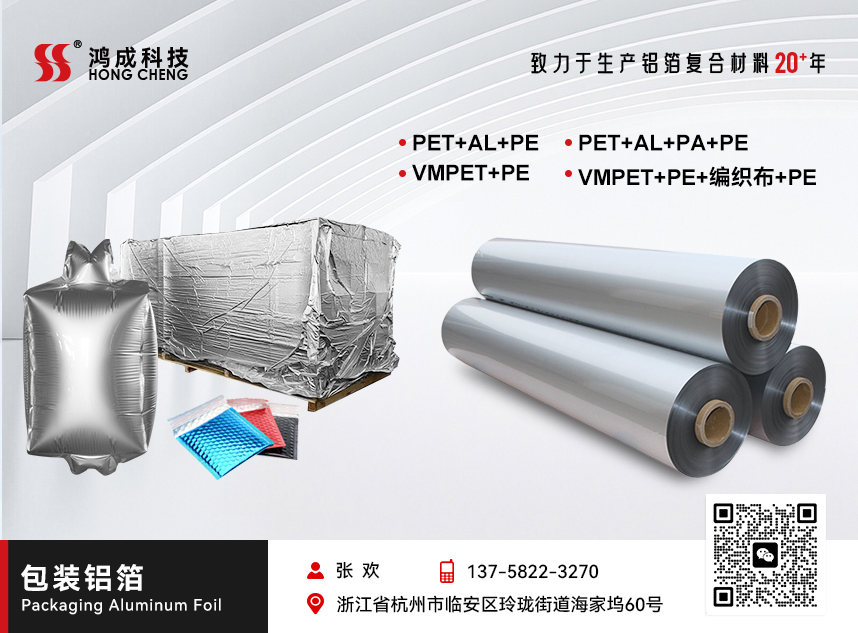
Hongcheng Technology is a dedicated raw-material supplier of aluminum foil laminates and PE extrusion-coated composites, providing AL/PE and PET/AL/PE aluminum-plastic film rolls and metallized film laminates to waterproofing membrane plants and insulation product manufacturers. Aluminum gauge, PE layer ratio and roll width are all specified to project requirements. To be clear about scope: we supply raw material rolls only and are not involved in finished waterproofing membranes or roof installation. Membrane plants are welcome to send samples and enquiries.
+86 13758223270、Email: wendy@hcdxcl.com.cn
Techfoil
How to Choose Foil Laminate for Warm Edge Spacer Bars: Key Points for Insulating Glass Converters
Heating Cable Market Expansion Creates New Demand for AL/PE Foil Sheathing Laminate